The evolution of the Tampa Riverwalk
Over five decades, the Tampa Riverwalk has gone from an idea to a key and expanding piece of the city’s transportation network.
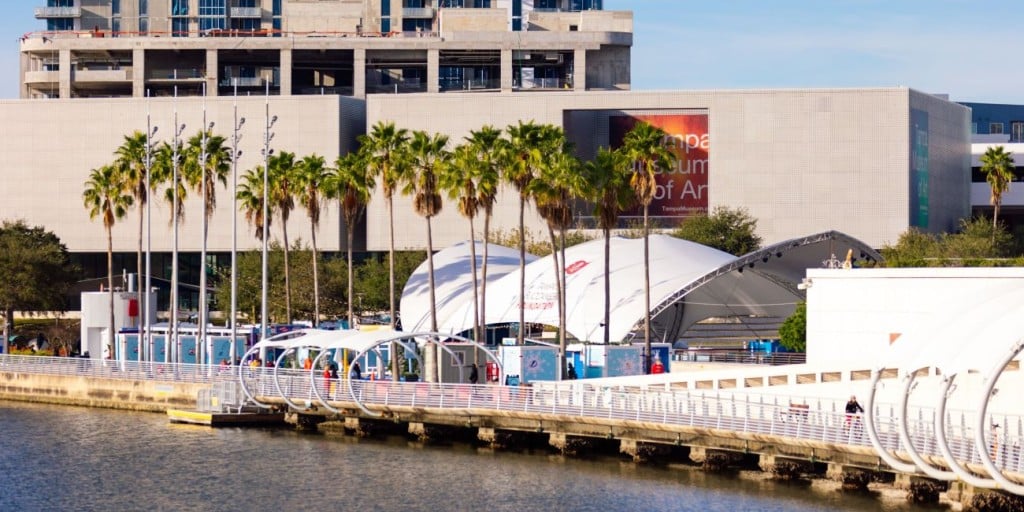
Tampa’s hottest new club is…the Riverwalk. On any given evening, the Tampa Riverwalk is a Gen Z fashion show, a first date circuit, a stroller parade, and a workout track. It’s also one of the most ambitious pieces of public infrastructure Tampa has built in the last half century.
What began as a long-range civic idea has become something far more consequential. It is not just a place to go, but a way to move, less an amenity than connective tissue. What was once a novelty is now, in many ways, the beating pulse of the city learning.
It is a story about the transformation of a city, the opening of a waterfront to the public, and a decades-long effort that continues.
The beginning
The concept of a riverwalk was first floated in the 1970s, but like many civic ambitions in Tampa, it took decades and no small amount of coordination to materialize. Segments completed in the early 2000s felt quaint, even charming, but disconnected. Downtown Tampa was still emerging from decades as a nine-to-five business district, largely empty on nights and weekends.
Over time, as additional segments were funded and stitched together, a larger vision for a continuous, walkable path along the Hillsborough River took shape. Investments like Curtis Hixon Waterfront Park and connections to Tampa Heights and Water Street help drive the transformation of the urban core. And then, something shifted. The Riverwalk evolved from a recreational amenity to a key piece of the city’s transportation network.
“The Riverwalk is essentially funded as a transportation venue,” says Friends of the Riverwalk Executive Director MaryBeth Williams. “We just have to figure out how (walkers, bikers, rollerbladers, etc.) can safely coexist.”
“It’s another major mobility mode,” adds Friends of the Riverwalk Board Chair Keith Greminger.
From amenity to infrastructure
Today, the Riverwalk spans roughly 2.6 miles from Tampa Heights to the Channel District. For much of that distance, pedestrians and cyclists can move uninterrupted, without traffic lights, crossings, or cars. It’s a departure from the past, when automobiles took priority.
“It’s not just that it’s there,” says Fred Jones, design-build firm Haskell’s project manager on the Riverwalk’s westward expansion. “Success is people using it…feeling like they’re part of downtown.”
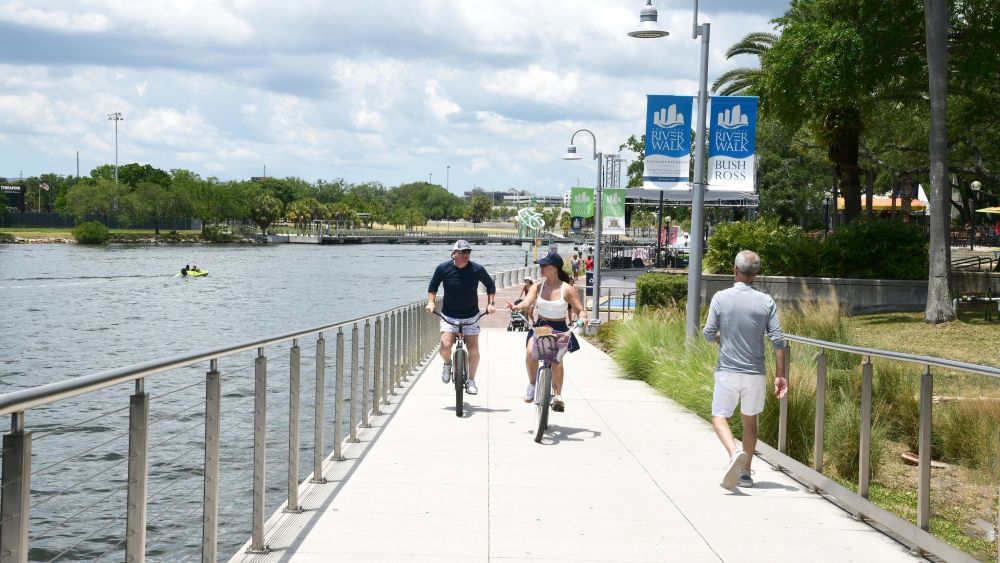
And they are using it: families with strollers, joggers, University of Tampa students, and cyclists weaving through the flow. The Riverwalk doesn’t just connect places. It connects people. For a few days each year, The Riverwalk also becomes a stage.
Friends of the Riverwalk’s signature annual event, Riverfest, which starts May 1, stretches the entire length of the Riverwalk. Concerts fill Curtis Hixon Waterfront Park, while food festivals, a lantern parade, paddle events, and even a wiener dog derby spill into surrounding parks and public spaces, drawing thousands of residents into the same space.
It’s also a reminder that the Riverwalk gets by with a little help from its Friends.
While the City of Tampa owns and maintains the physical infrastructure, with Parks & Recreation handling cleaning and upkeep, and the mobility department leading capital projects, much of the day-to-day experience is shaped by Friends of the Riverwalk. The nonprofit, with a staff of just three, manages programming, partnerships, fundraising, and provides the coordination required to activate the linear public space.
In practice, the Riverwalk sits somewhere between a public works project and a cultural institution. It’s built by the city, but brought to life through constant stewardship.
Now, it’s expanding to provide a connection to areas of the city that haven’t historically had it.
`Expanding access to West Tampa
The West River BUILD project, currently under construction, will extend the Riverwalk along the west side of the Hillsborough River, linking Downtown to West Tampa, Julian B. Lane Riverfront Park, Blake High School, and beyond. When complete, the Riverwalk and its connected network of trails and crossings will approach 12.5 miles.
The expansion will create access.
“This will allow West Tampa residents to get in and out of downtown by foot or bike, protected from vehicle traffic,” says Nina Mabilleau, the City of Tampa’s project manager overseeing the effort.
Many of those users, including students, workers, and residents without cars, have historically been cut off from the kind of seamless access the Riverwalk provides on the east side.
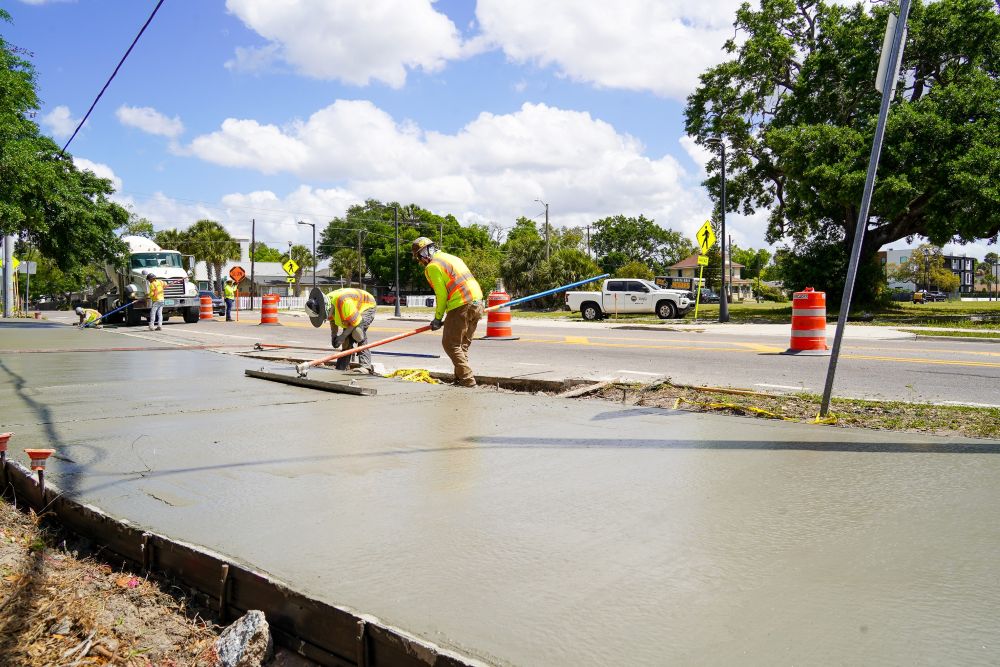
Building something like this is far from straightforward. The project’s cost has nearly doubled, from an initial estimate of around $30 million to $56 million, driven by rising construction costs and the complexities of working along a waterfront. The project received a $24 million federal grant, originally structured as an 80/20 match, though rising costs have shifted the balance closer to an even split.
“There’s always some new twist,” Mabilleau says.
Utility conflicts, property easements, and environmental considerations have to be coordinated with a web of stakeholders. Even the design reflects compromise.
“This phase is baking the cake,” Jones says. “The decorations come later.”
In other words, build the bones first. Lighting, landscaping, and gathering spaces will follow. That tension between vision and reality runs through the Riverwalk. It shows up in small ways, like the need for more shade structures in Florida’s heat. And it shows up in larger ways. Long-discussed improvements remain outside the current project scope, including a Cass Street underpass to eliminate one of the Riverwalk’s most awkward crossings.
Growth, pressure, and the next phase
Paraphrasing Yogi Berra, Greminger says, “The Riverwalk is so busy that nobody goes there anymore!”
Growth brings pressure. More users mean more expectations, more demand for improvements. Growth also raises larger questions about what kind of city Tampa wants to be.
For Greminger, the Riverwalk is part of a larger shift toward a more connected, walkable urban core. Projects like the North Downtown Vision Plan aim to reconnect street grids, create mixed-income housing, and reduce reliance on cars as part of a broader push toward a “20-minute city.”
“You shouldn’t have to get in your car,” he says. “You should be able to walk.”
That vision is still emerging, and still unevenly distributed.
While Bayshore Boulevard has historically been most accessible to those living in South Tampa, the Riverwalk’s expansion will create a more inclusive network connecting neighborhoods across income levels and areas of the city.
“This is about quality of life for residents that may have been somewhat left behind,” Jones says
A project decades in the making
While the Riverwalk is celebrated as an achievement five decades in the making, not everyone sees that timeline as a point of pride.
“People like to say it took 50 years and nine mayors,” says Christine Acosta, founder of Pedal Power Promoters and a board member with Walk Bike Tampa. “I don’t think that’s a good thing.”
It’s a fair critique, and a useful one. The Riverwalk demonstrates that building a city requires coordination, funding, persistence, and tradeoffs to make a vision a reality.
For more information, go to West River BUILD Project
Author

Related Articles
Partner Partner Content Preparing Tampa Bay for the next generation of growth
THEA commits $767.7 million to strengthen mobility, modernize operations, and prepare Tampa Bay for future growth.
Tampa’s West Riverwalk expansion rolling along
Part transportation project, part economic development catalyst, Tampa’s West Riverwalk expansion is taking shape.
Transportation projects will help shape Westshore’s future
Massive regional transportation projects and local infrastructure improvements will impact Westshore’s evolution into mixed-use district