St. Pete Innovation District looks to build on Hub’s success
Innovation District wants to expand Maritime and Defense Technology Hub with a second, larger building.
Growing up on St. Petersburg’s southside, Pat Mack went fishing with his grandfather at the St. Pete Pier and taught himself computer programming out of Byte magazine. He developed a connection with the water and zest for technology that he’s carried through 24 years as a U.S. Navy officer, 16 years and counting as a tech company founder and CEO, and eventually back to his hometown.
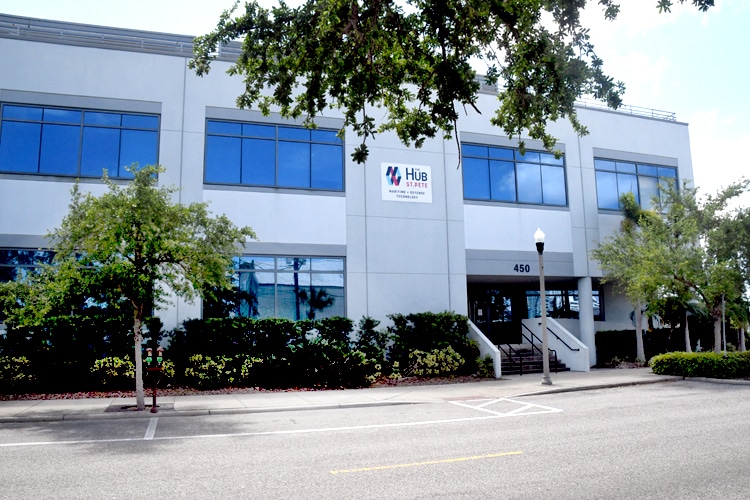
In 2021, Mack moved PVM, a software engineering and data analytics firm he launched in San Diego, to the St. Petersburg Innovation District’s then-newly opened Maritime and Defense Technology Hub at Port St. Pete.
Over the past four and a half years, PVM has flourished at the Hub, a shared workspace for marine science, defense, and technology firms. It is the largest minority-owned tech company in St. Pete, and the U.S. Small Business Administration recently named Mack its 2025 South Florida Veteran Small Business Owner of the Year.
The Hub was not part of the plan when the Innovation District launched in 2016. But as the district marks its 10th anniversary, the Hub and entrepreneurs like Mack have played a major part in a success story that has surpassed expectations. Looking ahead, the Innovation District wants to build on that success through an ambitious expansion plan to build a 52,000-square-foot building adjacent to the existing Hub. The new Center for Coastal Resilience would focus on developing solutions to adapt to climate change and sea-level rise.
Stepping up
The $10 million city-owned building that houses the Maritime and Defense Technology Hub was built for SRI International (formerly Stanford Research Institute), a nonprofit research and development group that arrived in St. Pete with high expectations and lofty job-creation goals and eventually vacated the building after it did not achieve them.
In 2021, the Innovation District assumed management of the 32,000-plus-square-foot building under a five-year lease with the city and began recruiting prospective tenants to sub-lease space. Innovation District Executive Director Alison Barlow says the district leaned into its strengths while recruiting and assembling a curated group of tenants – the growing blue economy centered around the marine science research, education, and entrepreneurship in the district, and the region’s robust national security and defense industry with U.S. Central Command and U.S. Special Operations Command housed right across Tampa Bay at MacDill Air Force Base.
“The idea was, these are core competencies we already have, let’s create clusters around them,” Barlow says.
The Innovation District also worked to attract companies that could utilize the building’s custom features: wet/chemical labs, deep-water port access, and rooms with secure communications.
A mix of startups and established firms flocked to the Hub, quickly filling it to near capacity.
“The city was left with a building that stood vacant for a while; they didn’t know what to do with it,” says St. Petersburg Downtown Partnership CEO and current Innovation District Vice Chair Jason Mathis. “Alison and the district took it over and turned it into this incredible success. That has been a great incubator. It has launched many businesses and helped provide a lot of jobs.”
Attracting attention
The Hub raised the Innovation District’s profile
“The Hub attracted companies from around the country and raised the profile and visibility of the work going on here in the maritime space,” Barlow says. “That got people’s attention. They were able to see, ‘If I go there, I’ll have more opportunities than where I am based.’ Now we have conversations all the time with people about our maritime industry.”
The attention put the Hub and Innovation District on the National Oceanic and Atmospheric Administration’s (NOAA) radar, leading to a $250,000 grant for the Innovation District, startup support organization Tampa Bay Wave, and the University of South Florida to partner on a blue tech accelerator for startups working on climate resiliency solutions. That led to a second $13.9 million NOAA grant for a larger group of partner organizations to form The Continuum, a network of business accelerators and commercialization programs focused on the blue economy and solutions to environmental challenges. So far this year, The Continuum has awarded more than $1.5 million in funding to 18 startups.
Innovating for solutions
The Hub brings together more than 20 businesses and organizations working to advance technology and develop solutions to real-world problems. Private businesses interact and collaborate with government agencies like the Florida Fish and Wildlife Conservation Commission, which works on red tide observation and research from space at the Hub, and academic and research entities like the USF College of Marine Science, which runs the Florida Flood Hub for Applied Research and Innovation out of the Hub.
The innovative maritime and defense tech firms include Saildrone, which maintains an operations hub for drone missions collecting real-time ocean data related to climate change, ocean mapping, national security, and renewable energy. Hub tenant SubUAS LLC has launched a dual-domain drone system, “The Naviator,” that moves seamlessly between airborne and underwater operations.
After retiring from the Navy, Mack, the St. Pete native and tech entrepreneur, launched PVM to develop a solution that delivers accurate, actionable data to military, defense, and government agency decision-makers more quickly. The firm’s mission, he says, is to “serve those who serve.”
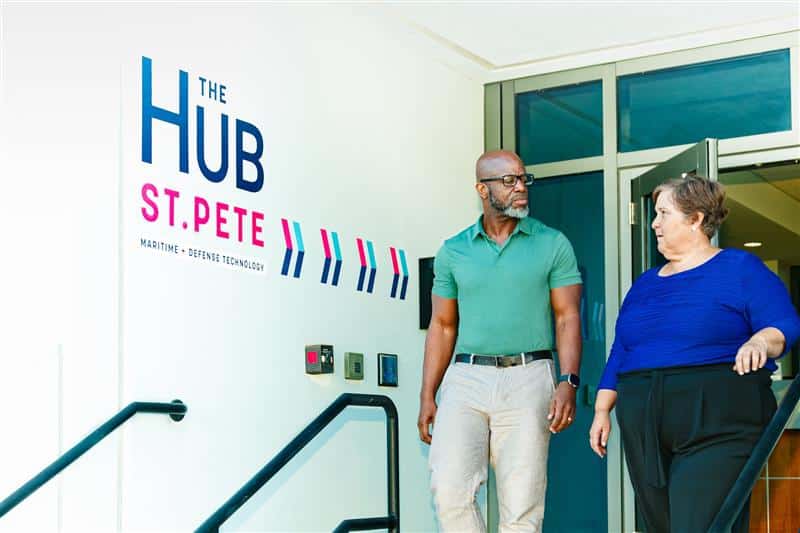
At the Hub, collaboration is in the salt air. PVM previously partnered with fellow tenant Pole Star Defense to upgrade the U.S. Coast Guard’s track management system for vessels. It’s also collaborating with the Florida Flood Hub for Applied Research and Innovation to improve the management and dissemination of data on sea-level rise and flooding.
Mack says the Hub tenants’ proximity, shared mission, and sharing of expertise, combined with the Innovation District’s connections and knowledge of the local innovation landscape, build a foundation for growth and success.
“I live by a simple principle: we are better together,” he says in an email interview. “It’s how I’ve approached everything we do at PVM, and it’s exactly what the Hub and Innovation District make possible. When we came here in 2021, we weren’t just looking for office space. We were looking for a community that believed the same thing. We found that in the Hub … Everyone in the Hub signed up for this. Not just to make money, but to solve critical problems. That shared purpose — that’s what ‘we are better together’ actually means in practice.”
Born on the Isle of Man in Britain, Christopher Stott now operates data centers on the moon and in lunar orbit from the St. Pete waterfront. Stott, who is married to Clearwater native and retired NASA astronaut Nicole Stott, is the founder and Executive Chairman of Lonestar Data Holdings, a Hub tenant developing space-based data storage systems that provide additional security and redundancy.
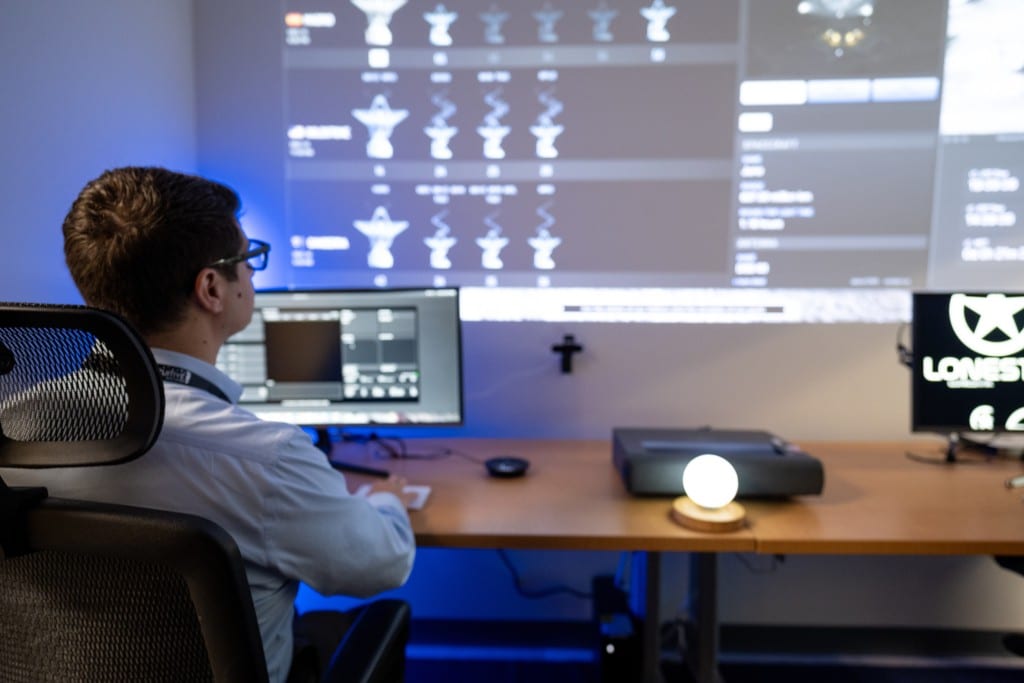
“St. Pete is a fantastic city for startups,” says Stott, whose three-decade career includes time with NASA, Boeing, McDonnell Douglas, Lockheed Martin, and as a founder and entrepreneur. “It reminds me of Austin, Texas, twenty-five years ago, the focus and concentration of entrepreneurialism.”
As a company working with secure data, a location like the Hub is crucial, he says.
“It’s been pivotal,” Stott says. “We couldn’t do our work without the Hub. The world that we work in – working with different governments, working in space, defense, aerospace – we can’t just go into a regular shared workspace. The Hub has been brilliant because it’s made for exactly the kind of company we are. We needed somewhere that understood defense, understood aerospace, and was secure. That’s just one benefit of being part of the Hub. The other is just the wealth of companies also working in maritime, defense, and space. We’re a very similar bunch of people.”
Local tech entrepreneurs regularly network and exchange ideas at events such as the Hub’s Tech X-Change happy hour series. As a condition of their lease, Hub companies are also actively engaged in the St. Pete community through local hiring, internships, peer mentoring of fellow entrepreneurs, and technical exchange events.
Looking ahead
Barlow says the proposed Center for Coastal Resilience would be uniquely positioned to develop solutions for adapting to climate change and sea-level rise. It’s located in a hotbed of marine science research, entrepreneurship, and education that’s become a magnet for talent. Its waterfront location means that the building’s design and construction will need to include resilience solutions such as wet flood-proofing.
To secure the financing to build the Center for Coastal Resilience, the Innovation District needs a new long-term lease with the city. Since the city charter places time limits on leases of city-owned waterfront property, the lease extension will have to go to the city’s voters in a referendum this November.
For more information, go to St. Pete Innovation District and Maritime and Defense Technology Hub
This story is produced through an underwriting agreement between the St. Petersburg Innovation District and 83 Degrees.
Author

Related Articles
Partner Partner Content Preparing Tampa Bay for the next generation of growth
THEA commits $767.7 million to strengthen mobility, modernize operations, and prepare Tampa Bay for future growth.
St Pete Innovation District celebrates 10 years, looks to future
The St. Pete Innovation District is a hub of research, entrepreneurship, education, and collaboration.
Partner Partner Content CDC of Tampa to expand workforce training with FabLab
CDC of Tampa’s upcoming community-focused initiatives include new FabLab, veterans housing, youth fire academy, and annual fundraiser.