UT startup team innovates mobile education solution for urban slums
University of Tampa team Tembo competes to win the Hult Prize, including $1 million in seed funding to help educate children in urban slums around the world.
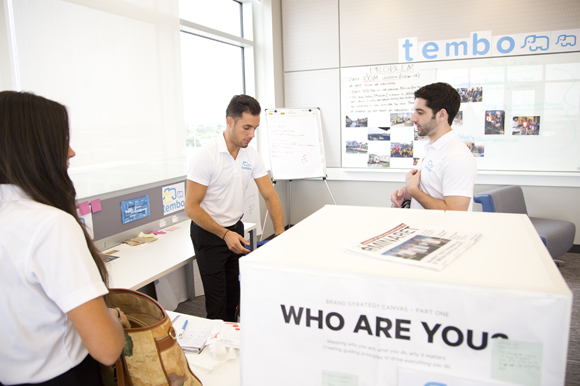
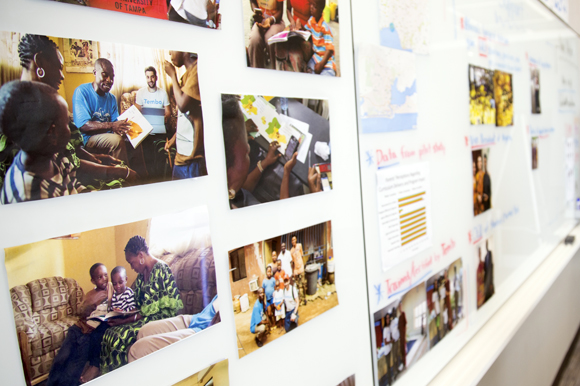
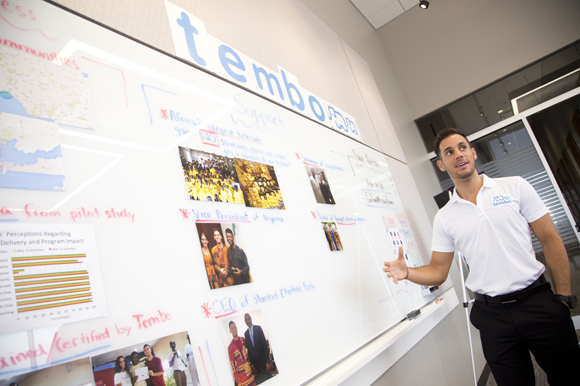
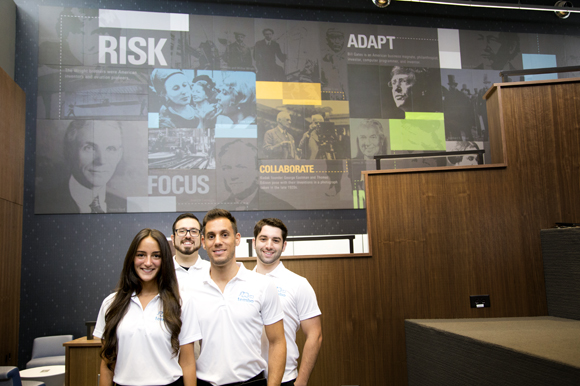
In Swahili, the word “tembo” means elephant. Traditionally in African culture, the elephant is a symbol of the astute and the gentle.
For Tembo founder Phil Michaels, this was the perfect word to describe a social venture startup focused on bringing education to young children in urban slums.
Elephants became an inspiration, Michaels says, because they “are known for being great mothers, very wise animals — and our education focuses on the mothers of the children.”
Tembo (formerly Athollo) relies on a simple concept: mobile phones and SMS text-message-based education, dispersed globally to mothers and home educators in impoverished communities where education is sometimes inaccessible or unavailable. Through partnerships with telecom providers, Tembo gives parents and home instructors in urban slums access to curriculum necessary for educating young children.
“When you see a mother watch her child become educated, and show off her child’s intelligence, it’s just such a beautiful moment,” Michaels says. “We’re empowering them to become their child’s first teacher — their most important teacher.”
Tembo team members will present their story — and solution — in front of former President Bill Clinton at the Clinton Global Initiative Annual meeting on September 26 as the final step in the Hult Prize competition.
If they win, the team will earn $1 million in prize money.
Building roots in Tampa Bay
Tembo is one of seven non-student teams to secure space at the University of Tampa’s newly opened Innovation and Collaboration building. To designate space, UT faculty “selected businesses from around the community that they want to incubate and grow into a viable, long-standing sustainable and scalable business,” says Michaels. “That’s what we hope to be.”
Tembo team member Sercan Topcu, who recently graduated from UT with an MS in Marketing, enjoys the late-night and early-morning access that team members have to the space. “When it’s quiet, you can hear yourself think a little bit better.”
The well-lit eighth floor Tembo office boasts an outdoor terrace with an expansive view and sits just around the corner from state-of-the-art videoconference rooms and a pitch room, as well as an amphitheatre-style pitch practice space and cozy Google ‘think pods.’ There’s even a dedicated space on the floor for mind games and puzzles, where entrepreneurs can unwind.
Tembo has been building since fall 2014; Michaels, a UT dual MBA and MS graduate who is also campus director for the global Hult Prize challenge at the University of Tampa, recruited other UT students to join the team: Topcu, along with Brent Caramanica, UT class of 2016; Ulixes Hawili, UT class of 2017; and Samantha Taranto, ’15.
The team takes their efforts to expand seriously; in advance of the Clinton Global Initiative Annual meeting, Tembo met with Schifino Lee advertising firm to finalize a script for their pitch.
Each year, the Hult Prize social entrepreneurship competition challenges students to develop an innovative idea surrounding a social or economic issue. For 2015, the challenge was to develop a solution that would educate 10 million children, ages newborn to 6, living in urban slums by 2020.
Tembo joined competitors from across the globe, including another team from UT, to address the issue of early childhood education in urban slums. Tembo won both regional and national Hult Prize competitions to claim a spot in the top six — the only team from the United States to make it to the final round of the competition.
Even before the Hult Prize winner is announced, however, team Tembo is thinking long-term. In mid-September, Michaels presented at IBM Smartcamp at the Berkeley Incubator in NYC, which offers winners the chance to pitch on stage at LAUNCH Festival and compete for a $25,000 investment prize; the team also won first place, public vote, in the Seedstars World $1.5 million competition in Geneva.
“We’re looking to scale this up to a level where it’s sustainable,” Topcu says. “Anyone who wants to be a change-maker can contribute.”
Education through innovation
Here’s how it works: Tembo uses community outreach to develop contacts in blighted areas. Through an evidence-based curriculum known internationally as HIPPY, these individuals become trained home educators and head out into the community to visit parents at home and review lessons, which are sent out daily to all phone numbers on the network. Then, it’s up to parents to share their schooling with their young children.
To encourage parents to teach their kids the lessons, Tembo offers incentives in the form of mobile phone minute “top-ups” if parents correctly answer quiz questions about the material.
Michaels spent two and a half months living in Nigeria to implement the business and to develop a proof of concept.
“We started out with a pilot study just to validate our study, but it got to a point where it was going so well that they didn’t want us to leave,” Michaels explains. “We decided to stay — I cancelled my flight back to America and stayed an extra month.”
During those extra weeks in Mushin, Michaels trained the home educators to run the program without the team being present. “It’s just been amazing,” he says. “They’ve been sending us pictures.”
While Tembo set out to provide free services to Nigerians, Michaels found that a low-cost solution was more effective: “They don’t respect or appreciate things that are free. So, we started charging them, which is how we started collecting revenue — that’s where the real ah-ha! moment came for us. As long as you show then how educating their young child is going to change their life for the future, that’s when they really become incentivized.”
As part of their long-term plan, Tembo aims to educate millions of children and to create employment opportunities across Nigeria and, eventually, all of Africa. Tembo has already performed outreach in communities including Makoko, Shomulu, Badia, Ilaje, Ikorodu, Egbeda, Lekki, Mushin, Idimu and Akowonjo.
Tembo plans to expand to Kenya, Ghana, Uganda and Liberia within five years, and aims to make the education more accessible globally.
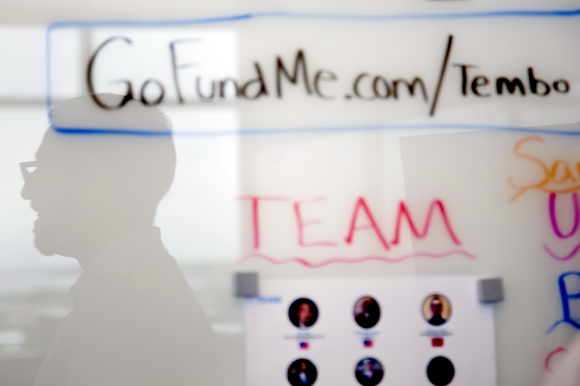
To learn more about the team’s efforts, watch this video. To financially support the team, follow this link to the Tembo GoFundMe campaign, which has raised more than $12,000 of its $53K goal.
Author

Related Articles
Partner Partner Content CDC of Tampa helps reach American dream of homeownership
CDC of Tampa’s innovative programs make housing affordable, attainable, and sustainable.

Spring training in full swing across Bay Area
Grapefruit League spring training runs through March 24th.

Slowing down Ybor City’s Seventh Avenue
Tampa officials unveil safety improvements on Ybor’s Seventh Avenue following high speed chase and crash that killed four.