Partner Partner Content Year-end gifting: Strategies for family, charity and your financial future
Explore year-end gifting strategies for 2026, including gifts to family, charitable donations and ways to coordinate your broader financial planning.

For many investors, 2026 has been a year of especially strong investment performance. As December approaches, now is a good time to ask yourself, “Has this year’s growth changed what you can or want to do with your wealth?”
Strong market performance can create new planning opportunities, but it can also make familiar decisions more complex: how much to give, which assets to use, when to act, and how those choices fit within a broader estate and tax strategy. For some families, this may mean helping children or grandchildren today rather than leaving additional assets as a future inheritance. Others may want to increase charitable giving or begin a more systematic approach to transferring family wealth.
Put Year-End Gifting to Work
In 2026, an individual can generally give up to $19,000 per recipient under the federal annual gift tax exclusion without using any lifetime exemption. A married couple may be able to give $38,000 per recipient, depending on how the gifts are structured. Consistent annual gifting can transfer meaningful wealth over time while also shifting future appreciation to the next generation.
Perhaps most importantly, a lifetime gift can help family members when it may matter most—funding education, for example, or a first home, starting a business or building financial security. It also gives you the opportunity to see firsthand the difference it makes in the lives of your loved ones.
Gifts above the annual exclusion do not necessarily result in gift tax, but they may require a gift tax return and use part of the donor’s lifetime federal gift and estate tax exemption.
Consider What You Give
After a strong investment year, what you give can be just as important as how much you give. Appreciated securities may be attractive for charitable giving: subject to applicable rules and limitations, donating directly to a qualified charity may provide an income-tax deduction while avoiding realization of the embedded capital gain.
A donor-advised fund (DAF) provides flexibility for distributing grants to your favorite charities over time. And higher-than-expected returns can create an opportunity to “bunch” several years of planned charitable giving into a single year, potentially providing tax benefits. Beginning January 1, 2026, an individual itemizer can deduct charitable contributions only to the extent aggregate contributions exceed 0.5% of Adjusted Gross Income. The rule applies to contributions to a DAF just as it does to other deductible charitable contributions. So bunching DAF contributions became even more useful as of this year.
For those age 70½ or older, a Qualified Charitable Distribution (QCD) from an IRA can be another tax-efficient giving strategy when paid directly to an eligible charity. A QCD can count toward an IRA owner’s required minimum distribution, if applicable.
Take a Broader Year-End View
A strong investment year can also affect your broader financial picture. Year-end is a good time to consider portfolio rebalancing, retirement plan contributions, potential Roth conversions, required minimum distributions, insurance coverage, beneficiary designations, account titling, and your overall estate plan.
Finally, do not wait until the last days of December to take action. Securities transfers, charitable gifts, trust distributions and other transactions, can take time to complete. If year-end gifting or planning is on your agenda, now is the time to get started. Your Florida Trust team can help with account activity and coordinate with your tax and legal advisors, so that you can enter 2027 on the right foot.
Ready to take a broader year-end view? Learn how Florida Trust Wealth Management can work alongside your tax and legal advisors to help coordinate your year-end planning. Visit floridatrust.com.
LEGAL, INVESTMENT AND TAX NOTICE: This information is not intended to be and should not be treated as legal advice, investment advice or tax advice. Readers, including professionals, should under no circumstances rely upon this information as a substitute for their own research or for obtaining specific legal or tax advice from their own counsel. Not FDIC Insured | No Guarantee | May Lose Value
About Florida Trust Wealth Management Florida Trust Wealth Management is an independent state-chartered trust company with more than $6 billion in assets under management that provides Family Office and Wealth Management Services, including investment management, trust administration and financial counsel to high-net-worth individuals, families, businesses, foundations and endowments. The firm is focused on wealth management services that are absolute-return oriented and performance driven. Originally established in 2001, the company operated under its flagship name of The Sanibel Captiva Trust Company for 25 years, including its divisions of The Naples Trust Company and The Tampa Bay Trust Company. Offices in Sanibel-Captiva, Fort Myers, Naples, Marco Island, Tampa, St. Petersburg, Belleair Bluffs and Tarpon Springs. floridatrust.com
Author

Related Articles

Comprehensive approach to improving early literacy producing results
Thrive by Five is a collaborative effort to reach families and children and improve school readiness. The goal is to have 65 percent of children ready for kindergarten by 2030.
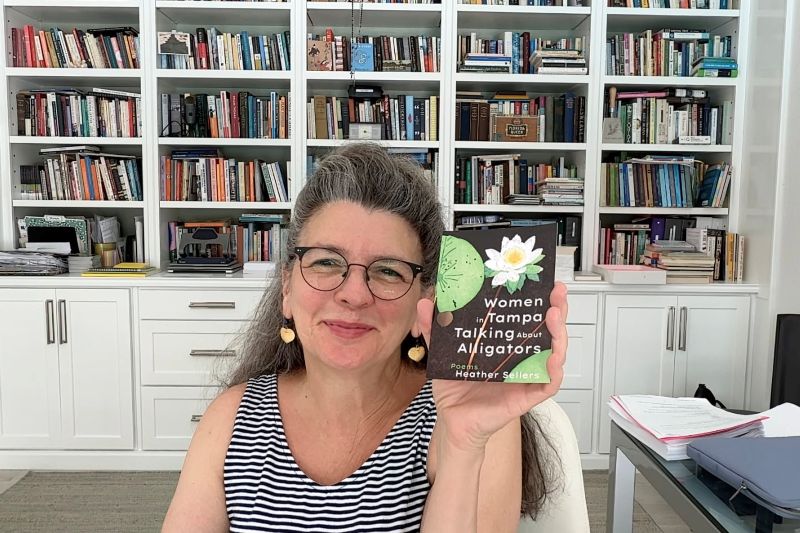
USF prof’s new poetry collection celebrates Florida’s daily rhythm
USF English professor Heather Sellers’ new poetry collection, “Women in Tampa Talking about Alligators,” is the final entry in a trilogy documenting her native Florida.

A new chapter for Tampa Bay’s independent bookstores
Across Tampa Bay, independent bookstores are making a comeback by offering a sense of place, distinct personality, and human connection that online retailers can’t match.