Transportation

U.S. Foodservice Seeks Salespeople, Drivers In Tampa Bay Region, Hiring

Dining outside the home in the Tampa Bay region offers a lot of choices as far as cuisine and location. Whether it's Thai food in a strip mall family restaurant, meat-and-potatoes at a stand-alone chain eatery or institutional fare at a hospital or school, someone has to transport the food from market to table and that's what the professionals who work for U.S. Foodservice, Inc. do for their customers. Three of the national food supply company's 60 distribution centers are in Tampa, Lakeland and Clearwater. Marilisa Henderson, a recruiter at the Tampa office, says fulfilling the appetites of Tampa Bay region gourmands requires hiring people who can select the best food products, fulfill and manage sales orders and deliver the goods. "We have an ongoing need for salespeople and drivers," she told an audience of job seekers during a networking event at Tampa Bay WorkForce Alliance. Henderson says she also sometimes has openings for IT professionals and people who can provide financial analysis reports. If there's a corporate creed that employees of U.S. Foodservice work by, it would probably be "go beyond the plate." Company spokesperson Christina Koliopoulos cites that as a commitment to communities as well as customers. "We do much more than deliver the groceries and each of our employees plays a critical role in protecting the safety of the food supply," she says. "We are also pasionate about giving back to our community. For example, the Tampa division was recently awarded recognition by Feeding America of Tampa Bay for its dedicated support in the fight to end hunger in West Central Florida."Writer: Brad StagerSource: Christina Koliopoulos, U.S. Foodservice, Inc.

Latest in Transportation
Largo Seeks Resurgence Through Redevelopment Of Downtown Core

The city of Largo's primary goal in seeking to shape the city's future is to increase density in the traditional downtown district. "We're not trying to recreate ourselves as a downtown St. Petersburg or Tampa," explains Teresa Brydon, economic development manager for the city of Largo. "We recognize our residents want moderate density. So what we're looking at is six-story buildings designed for mixed use; businesses with housing mixed in. "This process has been going on for a couple of years," Brydon continues. "We'd already started doing things before the plan was finalized. We added a Holiday Inn Express and a diagnostic clinic as part of the Largo Medical Center campus. So things have already started." According to Brydon, Largo is nurturing a medical community surrounding the hospital, its clinic and St. Michael's Eye & Laser Institute. But she says that whatever plans the city considers will ultimately be dictated by transit. "That will play a huge role in what we do." Brydon also shares that the city is attempting to attract the interest of developers, such as those attending this year's International Council of Shopping Centers (ICSC), which will hold an annual conference in Florida this year. "We're central," Brydon explains. "We're less than 10 minutes from the nicer beaches and the areas where most business employment is. The airports are close by. There's a lot going on and our downtown is the center of it all. We want to build a quality of life for all ages so they can work and live in the same area or catch a train to Tampa or wherever else they need to go to do business."Writer: Missy KavanaughSource: Teresa Brydon, City of Largo

Call To Action: Tampa Bay Region “Luckiest Place,’ Vote “Yes’ For Mobility

The importance of urban growth and creating greater mobility captured the attention of leaders from around the Tampa Bay region as they gathered in a Congress of Regional Leaders on April 16 at the Tampa Convention Center. Keynote Speaker Robert Grow, founding chair of Envision Utah, addressed the assembly to talk about his state's experiences building consensus on growth and to encourage excitement about the unique opportunities high-speed rail could bring to the region. "You are the luckiest place in America right now," Grow says. "This is your opportunity to win or lose for Florida big time." Improving mobility across the Tampa Bay region is critical to its ability to thrive in the global marketplace, says David Singer of Moving Hillsborough Forward, a county advocacy group working on behalf of the 1 percent surtax that will be on the November ballot. "Tampa needs increased choice when it comes to mobility options. Here in Hillsborough County we don't want to be relegated to driving everywhere anymore,'' Singer says. "Forbes magazine ranked us 60th out of 60 in terms of worst commutes in the country. People are making judgments about our area based on that piece. "It's an important issue not only to attract jobs and give people mobility, but to keep our young people here. When corporations look for headquarters or relocations, the first question they ask is, 'What does the transportation landscape look like?' We don't want local talent leaving the region. Increasing numbers of our graduates are going to Charlotte, Phoenix, Denver. These cities are poaching our talent because they do have light rail and modern transit." SunTrust banker Dan Mahurin, chair of ONE BAY, says, "Now it's up to each of us – both citizens and city and county elected officials alike – to do the hard work, make the right choices to turn this vision into a reality for our children and the generations to follow." Writer: Missy KavanaughSources: David Singer, Moving Hillsborough Forward; Dan Mahurin, SunTrust

One Bay Tackles How To Best Improve Tampa Bay Economy, Add Jobs

The St. Petersburg Times reports on a proposal that stresses the need for long-term planning to reduce sprawl while effectively attracting an additional 3.2 million people and 1.5 million jobs to the Tampa Bay region by 2050. The group behind the proposal is One Bay, a combination of organizations that includes the Tampa Bay Partnership, a regional economic development organization; the Southwest Florida Water Management District and the Tampa Bay Area Regional Transportation Authority (TBARTA).Read the complete story.

Lakeland Linder Regional Airport Receives Renovation Grant

Lakeland Linder Regional Airport got a windfall from the federal government last month, earmarked to improve traffic safety. According to a statement on the airport's website, the FAA awarded Lakeland Linder $2.4 million to "alleviate complex geometric intersections and improve the safety of taxiing aircraft at the airport." Construction is to begin this summer and be completed by the close of 2011. "Right now the taxiways leaving our hangers and terminal dump you into this area where the runway intersects with the taxiways,'' explains Gene Conrad, the airport director. "We're trying to take the confusion out of the mix in the interest of safety." The grant, and the renovations they will pay for, couldn't come at a better time. Conrad foresees big things for the airport in the near future. "We envision ourselves as a regional facility. We currently host smaller type aircraft but would like to attract scheduled public charters and a commercial airline. By giving us this grant, even the FAA recognizes that our airport is destined to be more than it is now. "We sit between Disney World and Tampa," Conrad continues. "And our location gives us the perfect opportunity for a commercial airline or a fixed charter line. I've only been here two and a half months, but in doing my due diligence on the area, I think the airport is a diamond in the rough." However, Conrad isn't looking to compete with the major airports in Tampa and Orlando. "We want to stay true to our core by finding our niche. We don't want to replace anyone. We just want to carve out our own niche for the local community." Writer: Missy KavanaughSource: Gene Conrad, Lakeland Linder Regional Airport

One Bay, One Vision: Mega-Meeting To Connect Tampa Bay Leaders

On April 16, leaders from across Tampa Bay will meet to discuss sustainable growth. One Bay, the group hosting the meeting, has deemed the event the Congress of Regional Leaders. The One Bay Liveable Communities Initiative is a "regional visional process" that grew from the Tampa Bay Partnership Regional Research and Education Foundation. It is committed to long-term thinking and planning to make the seven counties that comprise the Tampa Bay region a thriving and sustainable mega region by the year 2050. The counties included in the initiative are Hernando, Pasco, Pinellas, Hillsborough, Polk, Manatee and Sarasota. The April 16 meeting is a culmination of polls, surveys and workshops that resulted from the Reality Check of 2007. The data collected indicates a need and desire for a more proactive and deliberate approach to planning. "When we looked at the data, it was interesting because there were common guiding principles across transit, water and environmental areas," explains Betty Carlin, a spokesperson for the Tampa Bay Partnership. "It's telling us these are the things that people think are important. People really don't want to see growth happen as it has in the past. We want to do it differently. So now we have to put community leaders together to share the vision and make it happen." Dan Mahurin, chairman of SunTrust Bank and chair of One Bay, sees the meeting as a celebrated outcome as well as an exciting launch. "This event is a celebration of several years of great input and hard work from across the community to develop a shared vision for Tampa Bay. It is also a turning point for us to bring leaders back together to begin planning how we can implement this vision." The meeting will take place at the Tampa Convention Center from 8:30 a.m. to noon. Writer: Missy KavanaughSource: Dan Mahurin, SunTrust

Lakeland Contemplates Where High-Speed Rail Should Stop

When community and business leaders discuss what the proposed high-speed rail system will mean for the communities along the Interstate 4 corridor, Polk County is eager to participate. The railway system will stop somewhere in Lakeland. The question is, where?According to Nazih Haddad, COO of Florida Rail, the location decision is based upon a number of factors. "Ridership is a factor," explains Haddad. "We want the biggest bang for the buck. We are doing some analysis on ridership as we speak. The Polk Transportation Planning Organization's  number one choice is USF Polytechnic, and their second choice is Kathleen Boulevard. But who we contract for the project will also affect our decision about where we place Lakeland's stop." "No matter where it goes, it's going to be a tremendous opportunity for Polk County," says Jennifer Stults, TPO director. "You sort of target your growth in a concentrated area of mixed-use space. In those mixed-use spaces you can have living areas, commercial and retail all in one compact location. A lot of variety would make that station a producer and an attractor. With mixed-use you can attract people from other places as well as have people leaving their homes to go to work." Wherever the stop ultimately goes, Lakeland Mayor Gow Fields is ecstatic about the possibilities the high-speed rail system will have on his community. "The impact to Lakeland across the economic, commercial, cultural and transportation fronts will be enormous. We have only uncovered the tip of the iceberg in our comprehension and understanding about what this can do for our community and the entire region." Writer: Missy KavanaughSources: Nazih Haddad, Florida Rail Office; Jennifer Stults, Polk Transportation Planning Organization; Gow Fields, City of Lakeland

Port Of Tampa Expands, Prepares For More Panama Canal Traffic

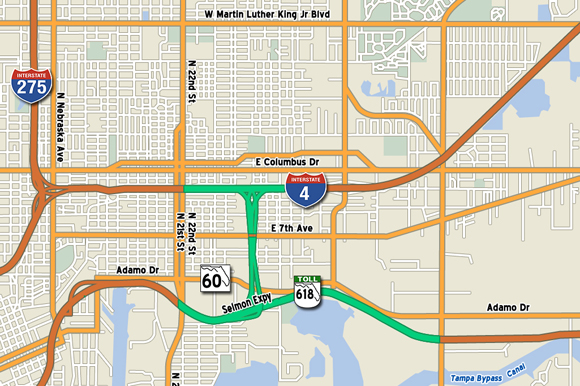
When the expected cargo blitz surges through the expanded Panama Canal in 2014, the Port of Tampa plans to be ready. The Tampa Port Authority has finished its latest phase of a long-term expansion that will eventually accommodate more than 1 million TEUs (20-foot equivalent units, a measure used for capacity in container transportation) per year. "We are very pleased to work with our partners Ports America, the Executive Shippers Council and our container carriers to ensure Tampa is well-positioned to serve the anticipated growth in Central Florida's overseas trade," says Richard Wainio, Tampa's port director and CEO, in a news release. "We will continue to move forward with a business-like approach towards investment in Tampa's container facilities". The latest phase increases paved storage space from 25 to 40 acres and adds another 2,100 feet of berth length. The terminal also added four cranes along its 43-foot-deep water channel to accommodate more container traffic through the port. More than 150 key exporting firms in the region should benefit from the Port's additional container space, because it may save them time and money traveling to more distant ports. In addition, the Florida Department of Transportation is building a ramp and connector leading from the port to ultimately connect with both Interstate 4 and Interstate 75 for faster access to commercial hubs in Orlando and Atlanta. The Interstate 4 corridor between Tampa and Orlando is the 10th-largest economy in the country, with a gross domestic product (GDP) of more than $272 billion. "The roadway will link Interstate 4 with the Selmon Expressway just west of 31st Street in Tampa," says John McShaffrey, a spokesman for the Florida Department of Transportation. "It will be east of downtown on the east side of the port and will link the Selmon with I-4 to significantly improve the movement of people and goods." McShaffrey says the new roadway will have exclusive truck lanes to keep Ybor City traffic congestion to a minimum. Writer: Missy KavanaughSources: Richard Wainio, Port of Tampa; John McShaffrey, Florida Department of Transportation

Florida’s High Speed Rail Proposal Draws Questions, Criticisms

The $1.25 billion high-speed rail project from Tampa to Orlando was recently examined by The New York Times. The article is critical of the stimulus-funded project's key components and also discusses alternative routes that would benefit from a high-speed rail.Read the complete story.

Lakeland Summit Addresses High-Speed Rail Connecting Tampa, Orlando

The Lakeland Civic Center hosted a group of businessmen, community leaders and visionaries  on March 24, 2010, who gathered to discuss the high-speed rail proposed between Tampa and Orlando. It marked the first meeting of its kind since President Obama announced that Florida would receive $1.25 billion toward railway construction. Tampa Mayor Pam Iorio, Lakeland Mayor Gow Fields and Orlando Mayor Buddy Dyer listened as representatives from the Tampa Bay Partnership, Central Florida Partnership, Florida Rail Enterprise and other entities with a stake in the proposed rail system presented their findings and plans related to the proposed route, which would run from Tampa's Ybor City and the Orlando International Airport. "We start today to create a vision, a template for connectivity," says Ed Turanchik, founder of ConnectUs, a grassroots organization. "High-speed rail builds a bigger community from smaller ones." Representatives from Florida Rail Enterprise presented an overview of the high-speed rail plan, which provides for stops at USF Polytechnic in Lakeland and Kathleen Avenue locations, Walt Disney Resort and the Orange County Convention Center. Dyer of Orlando and Ronnie Duncan of the Tampa Bay Area Regional Transportation Authority (TBARTA) spoke about their region's plans for additional rail service to augment transportation from the high-speed system to key locations throughout Orlando and the Tampa Bay area. These reports and others from Orlando's SunRail and Tampa's transit system sound promising, says Shelley Lauten, president of myregion.org and project director of Connecting for Global Competitiveness: Tampa Bay Central Florida Super Region. The Tampa-Orlando rail line is designed to become part of a bigger network that will link Orlando with Miami. Proponents of the plan say construction along the Interstate 4 corridor could begin as early as February or March of 2011, and conclude in 2015. Writer: Missy Kavanaugh Source: Ed Turanchik, ConnectUs

Our Partners

St. Pete Innovation District
THEA logo
JWB logo

Don't miss out!

Everything Tampa Bay, in your inbox every week.

Close the CTA

Already a subscriber? Enter your email to hide this popup in the future.