Government

New Shops, Cafes Open In Downtown Clearwater

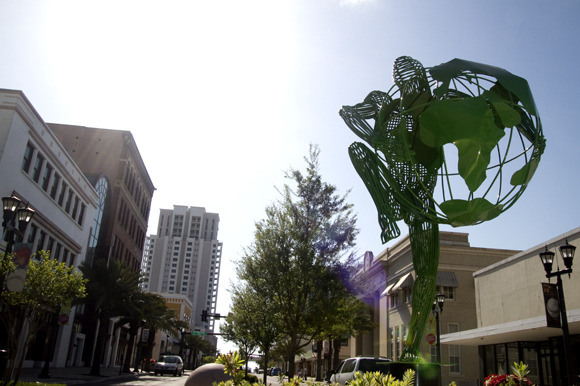
Once simply a route to Clearwater Beach, a newly revamped Cleveland Street is emerging into a destination on its own.The City of Clearwater has realized its three-pronged plan to transform Cleveland Street from a sleepy downtown thoroughfare to the beach to a downtown district. Cleveland Street runs from Drew Street just north of Route 60 to just shy of the Intercoastal Waterway.The city's strategy for improvements includes new and upgraded infrastructure, residential development and events to bring people downtown, according to Geraldine Lopez of Clearwater's Economic Development and Housing Department."We needed to give people a reason to come downtown," Lopez says. "We did studies that gave us ideas -- like a sidewalk cafĆ© district. So a lot of our incentives and programs surround recruiting restaurants and cafes. We also revisited our branding and logo. Instead of calling this area downtown Clearwater, we're calling it the Cleveland Street District.''Lopez says a number of businesses recently opened on Cleveland Street, including Casanova Restaurant & Lounge, the Hot Spot CafĆ© and I Care Medical Supply. Expanded businesses include Tony's Pizzeria and Peter Gillham's Nutrition Center, which expanded to two businesses: Gillham's Naturals and Green Organic Food & Wine Bar. New residential options include The Strand, Station Square and Water's Edge. Infrastructure improvements include boat slips along the downtown waterfront and an improved streetscape that includes public art."We have been focused on redeveloping downtown for the last 10 years," Lopez says  "For a number of years, you had to go down Cleveland to get to Clearwater Beach. But with the new bridge, traffic shifted away from Cleveland. Now people have a reason to go downtown."Writer: Missy KavanaughSource: Geraldine Lopez, City of Clearwater


Latest in Government
Beach Trolley Connects St. Pete To Tarpon Springs

For years, tourists and residents have enjoyed riding the Jolley Trolley from the beaches of Pass-A-Grille in St. Petersburg to the northern tip of Clearwater Beach and points in between. They can now extend that ride even farther north to the sponge docks of Tarpon Springs.The new route, which extends Jolley Trolley public transit service from Clearwater Beach through the downtown neighborhoods of Clearwater, Dunedin, Palm Harbor and the docks at Tarpon Springs, began on Nov. 17 and will run every weekend on Fridays and Saturdays until midnight and until 10 p.m. on Sundays."We have all these communities along the Alternate 19 corridor with these great downtown areas like Dunedin and Palm Harbor on up to Tarpon Springs," says R.B. Johnson, chairman of Pinellas Suncoast Transit Authority's board of directors. "The idea was to link these areas together to make it easier for tourists and residents to go to these areas of concentration without worrying about getting in and out of their cars."The route extension is financed through contributions made by the Clearwater Downtown Development Board, the municipalities of Tarpon Springs and Dunedin, Pinellas County and the Pinellas Suncoast Transit Authority. Jolley Trolley fare is $2 one way."It's helping promote these areas," says Johnson. "It works off of itself and builds up community. It fills that transit gap on weekends, going to restaurants and bar hopping from point A to point B, and points in between. We feel like we need to have better transit in north county. This is one small step toward that end."Writer: Missy KavanaughSource: R.B. Johnson, Pinellas Suncoast Transit Authority

Envisioning Florida’s Future: Amanda Beck, Tampa

"What Should Be Next For Florida?'' Young professional Amanda Beck envisions Florida's future on the political landscape. 83 Degrees invites young professionals to submit opinion columns of 600-800 words describing what they would like to see in Florida's future. What do you think?

Career Fair In St. Petersburg Dedicated to Veterans

WorkNet Pinellas will host a career fair for veterans on December 8 in St. Petersburg. The event will be from noon to 4 p.m. with the first hour dedicated to veterans only. The fair opens to the general public at 1 p.m. Haley Loeun, lead business services recruiter for WorkNet Pinellas, says the largely state-funded organization wants to help jobless veterans find work. "WorkNet has always had a deep commitment to our veterans and has veteran employment representatives on staff that work exclusively with the members of the armed forces," Loeun says. "Many employers are looking specifically for candidates who have served during the war, as these candidates often possess the highly desired security clearances, and have the skills and personal qualities that are in demand in the current market." Loeun gives the following advice to job seekers who plan on attending: "Use your time at the event to network and meet with representatives of the various companies. This is a great opportunity to learn more about their open positions and application processes as well as gain valuable insight into the culture of the company." She also advises attendees to wear professional dress, communicate effectively and make eye contact. "Ask for the recruiter's business card and discuss how and when you should follow up with the employer," Loeun says. Participating employers at the job fair include Coca-Cola, Lockheed Martin, Eckerd Youth Alternatives, the St. Petersburg Police Department, pTEC and Tech Data. The job fair will be held at the Pinellas Technical Education Center located at 901 34th St. S. in St. Petersburg. Worknet Pinellas is part of Workforce Florida. Writer: Kimberly Patterson Source: Haley Loeun, WorkNet Pinellas

Tampa’s Zack Street Arts Corridor Moves Forward

The city of Tampa plans to transform downtown Tampa's Zack Street to a Promenade of the Arts showcasing various forms of public art. The first phase of the project will begin in spring of 2011.According to David Vaughn, director of Contract Administration for the city of Tampa, the promenade will extend from Curtis Hixon Waterfront Park on the Hillsborough River to Nebraska Avenue near Interstate 275. "Phase I will include revamping Zack from the park to Florida Avenue," he says. "We'll be removing lanes and widening walks to make room for the art."Plans for the promenade include various forms of public art such as painting, sculpture, special lighting, lush landscaping and widened roads for ease of parking, walking and biking. Zack has been made a two-way street in preparation for its transformation.Vaughn explains that the promenade is part of the mayor's long-term plan for the downtown area."Back in 2006 the mayor appointed a committee to look at finding a street to be enhanced to celebrate the creative arts. During the latter stages of Curtis Hixon renovation, it became evident that Zack was the right choice, since it is located at the axis to the Tampa Museum of Art. It made sense to have a pedestrian street leading into and out of the park. Less than a year ago we went through a selection process and chose Graham Booth Landscape Architecture to design the streetscapes. We're in the process now of selecting a construction manager."Venues within close proximity to the new promenade include the Glazer Children's Museum, the Straz Center for the Performing Arts and the Tampa Theatre. Writer: Missy KavanaughSource: David Vaughn, City of Tampa Contract Administration

Downtown Tampa Completes Conversion To Two-Way Streets

Four streets in downtown Tampa that once ran one way now run in two directions, thanks to a long-term initiative to encourage urban living.After a transformation that took several years of planning and execution, Twiggs, Cass, Zack and Polk, all east-west thoroughfares through downtown Tampa, are now two-way streets.Tampa's Transportation Manager Jean Dorzback says the project, which was done one street at a time, was a multilayered task. "The traffic signals had to be redone, poles ordered, zoning and signage, parking meters. There's more to it than you would think."According to Dorzback, the impetus for the transformation was ultimately to encourage urban living. "One of the goals is to transform downtown to residential," she says. "Mayor Iorio's administration asked that we convert one-way streets to two-way to encourage residential living and make urban living more appealing. One of the initiatives of this was to convert one way to two way to make it easier for people to negotiate."Dorzback says that while east-west streets such as Kennedy Boulevard and Nebraska Avenue are still one-way,  the four streets chosen to go two-way were selected because they had the least impact on overall traffic patterns. "We had to be very careful to balance," she says. "We picked the streets that didn't have issues with capacity. These streets didn't have any impact on commuting from the interstates."Dorzback explains that final resurfacing and permanent markings are to take place as soon as work on the city pipeline system is completed. "Once we're finished with the UCAP pipeline renovations, we'll be able to resurface and put down permanent markings."Writer: Missy KavanaughSource: Jean Dorzback, City of Tampa

Tampa Activists Strategize For Future Of U.S.-Cuba Relations

Tampa-based activists are taking a pro-normalization stance toward the country's stance on the U.S.-Cuba travel policy. Activists Vicente Amor, owner of Tampa-based travel agency Flor Caribe, and Washington attorney Tony Martinez have started to reorganize their strategy to reach a united stance on U.S.-Cuba relations. Lifting the travel ban could be more difficult in the current political climate following mid-term elections, according to a recent article the Cuba Standard. Read the complete story.

Tampa Trash Tests New Solar-Powered Compactors

The city of Tampa is trying out solar-powered trash receptacles around the downtown area to see if they are a feasible option for permanent use.The "BigBelly" receptacles, provided by Waste Management, Inc., are run on 12-volt batteries recharged through solar energy. Each receptacle is equipped with sensors that automatically trigger compaction when needed, and send a signal when completely full and ready for emptying. The receptacles are located on the corners of Franklin and Madison, Kennedy and Franklin, and Franklin and Twiggs streets. "Tampa is joining a number of cities like Philadelphia that just deployed these compactors on the heels of the Obama administration's push for solar industry," says Tonja Brickhouse, director of Tampa's Solid Waste and Environmental Program Management. "We're working with the Tampa Downtown Partnership to see how these will work out for us."According to Brickhouse, one compactor can hold five times as much as one traditional receptacle can, which may reduce collections from 17 to five times a week, which translates to savings for the city. "Based on projections from Philadelphia, we can expect around $12 million in overall savings, including those for maintenance, labor and fuel," she says. "All of those variables over time point to a huge savings."This translates to less trucks on the road, more efficiency and less green house gas emissions from our trucks," continues Brickhouse. "It's supposed to over time translate to 80 percent savings on green house gas emissions. This system allows us to take the waste from the waste process."Writer: Missy KavanaughSource: Tonya Brickhouse, City of Tampa

What’s Next For Tampa Transportation?

Hillsborough County voters rejected a one-percent sales tax increase to fund improved transportation throughout the county, including the construction of a light-rail system. But supporters of the initiative are not giving up."We're taking stock of what occurred, what the voters told us, the lessons we've learned and what we can do differently," says Stuart Rogel, president and CEO of Tampa Bay Partnership. "We are looking at a variety of opportunities in front of us. The need for and importance of transportation to our future is still very, very important. Forty-two percent of the electorate voted for the one-cent tax to fund transit improvements and thought it was important enough to our future."Rogel says he feels collaboration has strengthened the push toward transit improvement funding and has helped to educate county residents and business owners about their options regarding transportation."We've established relationships among people who have never worked together before," says Rogel. "People who had never thought about what transit meant to our future are now thinking about it. Pinellas and Pasco counties are now looking at this issue. The Tampa Bay Area Regional Transportation Authority  (TBARTA) now has a master plan in place. We're starting to tie people together collaboratively."And Rogel emphasizes that a high-speed rail route is looming on the horizon. "I just spent time with people from all over the world meeting about the Florida high-speed rail project," he says. "We can't lose sight of that and what it means to our community." Writer: Missy KavanaughSource: Stuart Rogel, Tampa Bay Partnership

St. Petersburg Floats Central Avenue Makeover

Central Avenue in St. Petersburg stretches almost seven miles between Tampa Bay on the east side of the Pinellas peninsula to the Gulf of Mexico on the west. And the city of St. Pete has begun discussions to organize the diverse businesses along it.According to Paul Stellrecht, the city's economic development coordinator, the conversation has just begun."There is no plan at this time to do anything, be anything or create anything," explains Stellrecht. "The impetus for what we call a Conversation on Central was to bring together all interested businesses along the avenue from bay to bay. "There are so many different unique, diverse areas along the Central Avenue—and all of them are doing their own thing. Business owners who had never met the business owner across the street. So we wanted to come together and introduce all these areas to each other and kind of get an idea of what some of the assets of the avenue are. "There are a lot of unique activities going on along the avenue," continues Stellrecht. "The idea was to first explore the feasibility of a collective, collaborative vision while maintaining each area's individual characteristics. And the meetings revealed that it is possible."According to a news release, approximately 190 participants have gathered during four meetings to discuss the avenue's options. Guest speakers include members of the city's Police and Safety department, its Transportation and Parking department, business owners from the Grand Central Main Street district and representatives from the Artist Enclave of the 600 Crislip Arcade block.Improvements discussed include better lighting, coordinated curb appeal and security upgrades, to name a few."For me it's an exciting opportunity because we just don't know what's going to become of it," says Stellrecht. Writer: Missy KavanaughSource: Paul Stellrecht, City of St. Petersburg

Our Partners

Crisis Center of Tampa Bay
St. Pete Innovation District

We want to know what's on your mind.

Close the CTA

Don't miss out!

Everything Tampa Bay, in your inbox every week.

Close the CTA

Already a subscriber? Enter your email to hide this popup in the future.