St Pete Innovation District celebrates 10 years, looks to future
The St. Pete Innovation District is a hub of research, entrepreneurship, education, and collaboration.
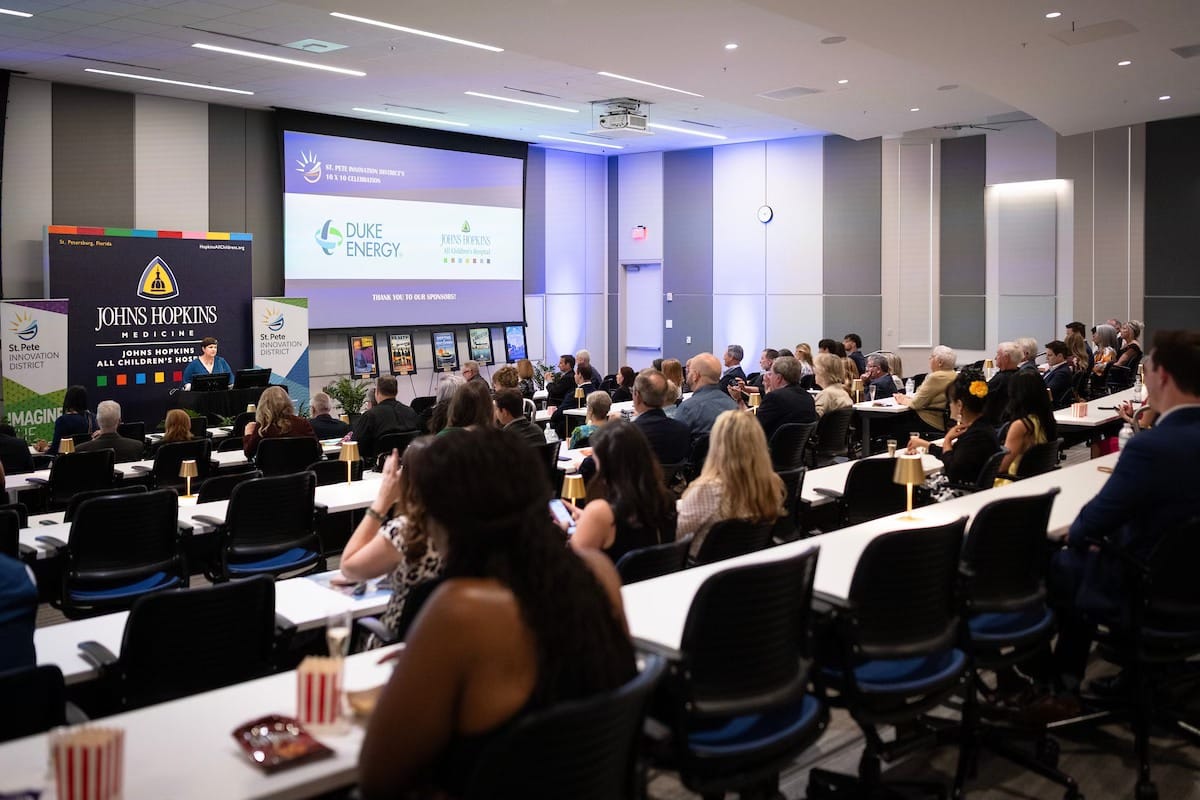
2026 has already been an eventful year for the St. Petersburg Innovation District. It reached the 10th-anniversary milestone, created a road map for future growth with its first-ever master plan, and rallied to support a cornerstone member after a fire tore through the University of South Florida College of Marine Science laboratory building in early May, destroying decades of research.
St. Pete is a city of residential neighborhoods and commercial districts, each with their own look and feel. Directly south of downtown, the Innovation District is 560 acres with two hospital complexes, a university campus, a marine research mecca, a business incubator, a marine and defense tech office hub, a world-renowned museum, an influential journalism institute, an airport, a port, and government, nonprofit, and private sector research organizations.
“Innovation districts are really interesting,” St. Petersburg Innovation District Executive Director Alison Barlow says. “They bring together the physical place with the economic drivers – the businesses, the incubators, the accelerators – and figure out ways to network all of those together. The way I describe it is, when one of our partners is doing really cool work, they own it, they 100 percent own it. Our job is to amplify, to raise awareness, get people interested, and help them find future partners. When it’s a project that needs multiple partners working together, that’s where we’re really good. We convene them. We lead them. We coordinate.”
Decade of investment
The Innovation District was officially established in 2016, just as one founding partner, All Children’s Hospital, was expanding its research and academic missions as a member of the Johns Hopkins Medicine system.
“It was perfect timing for us to be a founding member,” says Johns Hopkins All Children’s Foundation Executive Vice President Jenine Rabin, the hospital’s current representative on the Innovation District board. “It was right as we were activating the science and innovation part of our mission, even more than before. The fulfillment of that mission comes in 2018 when we build our Research and Education Building. Research and innovation are just pouring out of that building.”
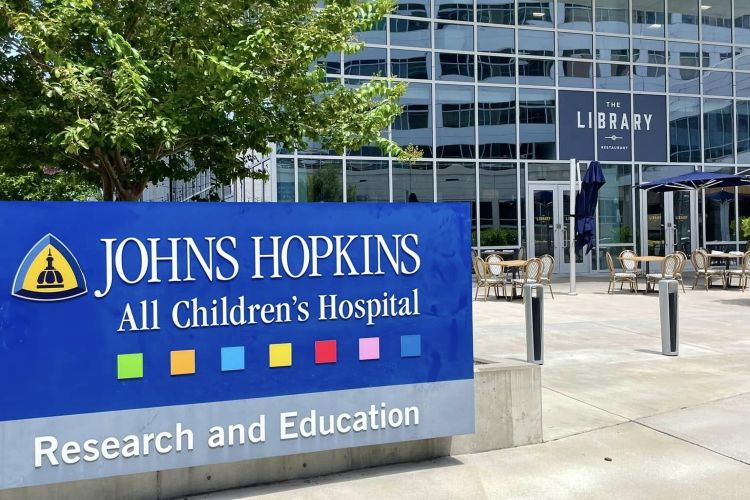
The $95 million, 230,000-square-foot facility houses six research institutes, a nationally accredited pediatric biodepository, a state-of-the-art simulation lab, grant-funded pediatric cancer research programs, more than 350 research studies on pediatric diseases, and medical resident training programs.
Johns Hopkins All Children’s expansion was not an outlier. Over the last decade, several anchor institutions helped the Innovation District live up to its name by making major investments in state-of-the-art facilities.
In 2017, USF St. Pete opened Lynn Pippenger Hall, which houses the Kate Tiedemann School of Business and a nationally recognized fintech accelerator program that Tampa Bay Wave runs in partnership with the USF Muma College of Business.
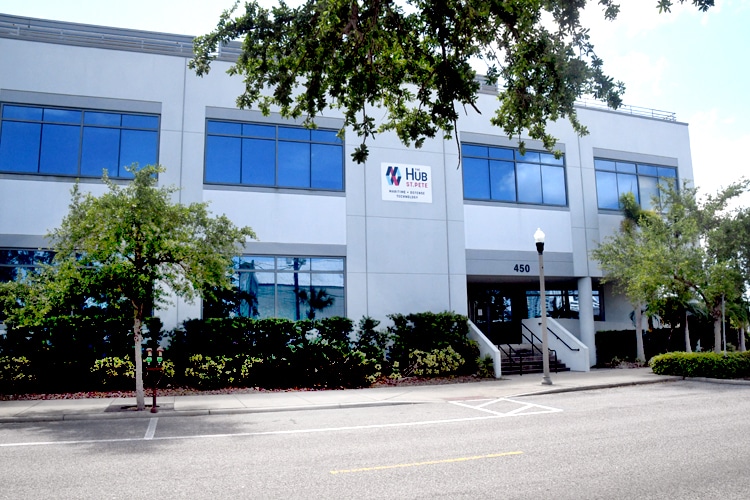
In late 2021, the nonprofit organization that manages the Innovation District repurposed a vacant research-and-development building at Port St. Pete as the Maritime and Defense Technology Hub (see related article), a shared workspace for startups and firms working in the defense, technology, and blue economy sectors.
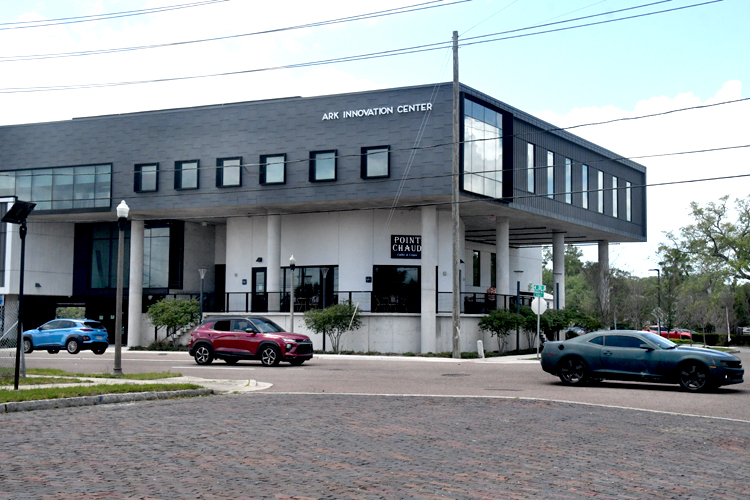
In early 2024, Tampa Bay Innovation Center’s $16 million, 45,000-square-foot ARK Innovation Center opened along Fourth Street South. Backed by noted tech investor Cathie Wood’s firm ARK Invest, the Tampa Bay Innovation Center rebranded as SpARK Labs by ARK Invest in late 2025, shifting the ARK Innovation Center away from a business accelerator model to a membership-based incubator for tech startups working on artificial intelligence, blockchain, robotics, energy storage, and multiomics biology. That incubator program reached its capacity of 45 firms in March.
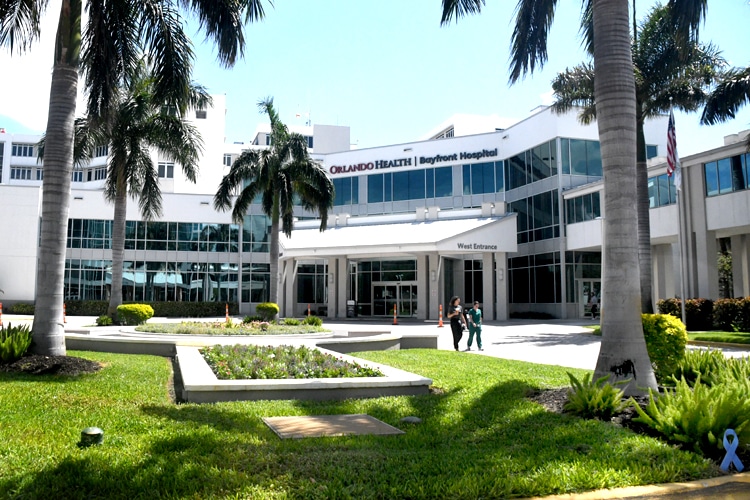
In February 2026, Orlando Health Bayfront Hospital opened its Institute Square complex. Covering a full city block, it includes a 132,000-square-foot medical pavilion that houses institutes focused on orthopedic, cancer, and neurosciences care.
By the numbers
Some numbers the Innovation District released to mark its 10th anniversary show the economic growth over the last decade. The district has had a $3 billion economic impact and supported more than 10,000 jobs. Two pillars, marine science and life sciences, have expanded significantly. Marine science adds $700 million to the local economy, a 274 percent increase since 2018, and supports more than 2,000 jobs, 1,300 of them added since 2018.
Centered around Johns Hopkins All Children’s and Orlando Health Bayfront, life sciences contribute $1.7 billion to the economy, a 112 percent increase since 2018, and added more than 2,000 jobs, pushing that sector’s total workforce to nearly 6,700.
The beginning
It all began as an idea for a hospital marketing strategy.
Back in 2011, current Foundation for a Healthy St. Petersburg President and CEO Kanika Tomalin was a C-suite executive at Bayfront Health System (now Orlando Health Bayfront) who devised the Innovation District moniker as a branding tool for the single-hospital health system.
“It was initially a strategy to leverage Bayfront’s proximity to the inordinate amount of anchor institutions that had organically developed over the course of a century along that corridor, creating this extraordinary opportunity for innovation,” Tomalin says. “We were looking at it for a marketplace positioning advantage in a crowded, competitive healthcare marketplace. We also saw it as a way to capitalize on opportunities to cooperate through shared office space or shared chillers. We were looking at it from a practical and operational point of view.”
The concept quickly expanded, leaning into strengths at opposite ends of the future district – the waterfront marine research cluster centered around USF’s College of Marine Science to the east, and, to the west, the bustling healthcare hub around Bayfront and All Children’s. The Innovation District would be the nexus that brings them together to share ideas and collaborate.
“There was a focus at the time on this construct of ‘warm, salty, wet,’ and the fact that healthcare and marine science both work in this wet lab space,” Tomalin says. “Many of the same shared principles of innovation were driving their work forward. In the collision that happens when people work together, new innovations can take place.”
In 2012, the stakeholder institutions and the St. Petersburg Downtown Partnership started meeting to flesh out the concept. In 2014, Tomalin moved to City Hall as deputy mayor in Rick Kriseman’s administration. She brought the campaign to establish the Innovation District with her. Working within city government in a position overseeing economic development, Tomalin says she cultivated the support to take the proposal “from the concentrated interest of the small group of stakeholders directly involved” to “a city priority.”
In 2016, the Innovation District was officially established on six foundational pillars that largely align with the City of St. Petersburg’s Grow Smarter job-creation strategy: marine science, life science, data and technology, entrepreneurship, education, and art.
Nine organizations with an established presence in the community became the “anchors”: the City of St. Petersburg, Duke Energy Florida, Foundation for a Healthy St. Petersburg, Johns Hopkins All Children’s Hospital, Orlando Health Bayfront Hospital, St. Petersburg College, St. Petersburg Downtown Partnership, USF’s College of Marine Science, and USF’s St. Petersburg campus.
“It got all the big institutions talking on a regular basis about shared goals, collaboration, and ways to build the local economy,” says St. Petersburg Downtown Partnership CEO Jason Mathis, current Vice President of the Innovation District board. “They already knew each other, but formalizing the district created this great mechanism for these institutions to collaborate and work together. And big institutions are not always great at that.”
Bringing Barlow on board
In 2017, the Innovation District board hired Barlow as the first executive director of the nonprofit organization that manages the district’s operations and convenes the partners. Tomalin, who helped interview candidates, says the hiring took the district from a “nice to have” to “a concentrated business operation.”
“We had a lot of great candidates,” she says. “But Alison stood out for her record of project management and her ability to translate a vision into reality in tangible ways that make the value proposition clear. She understood the possibilities and potential of the district right away. She has a commitment and ability to build bridges between like-minded people who are invested in the advancement of the district overall and the city as a whole, not just individual institutions. She’s a great ambassador and continues to come up with new and exciting ideas worthy of the Innovation District every day.”
Barlow grew up in St. Petersburg and graduated from Boca Ciega High and Florida State University before graduate school at American University in Washington, D.C. After grad school, she worked in project management and technology consulting in D.C. Eventually, she moved back to St. Pete, where, in 2014, St. Petersburg College hired her to run its collaborative labs program.
Barlow says her initial focus at the Innovation District was spreading the word about the cutting-edge work being done by the researchers, scientists, academics, and clinicians in the district. They were working on solutions to real-world challenges like cancer treatments, chemical contaminants in Tampa Bay, sea level rise and flooding, health disparities, red tide, and political misinformation, and it was all flying under the radar.
“The first four years were really about amplifying what we already had and bringing visibility to things that people didn’t know about,” Barlow says. “There were people in the district who were rock stars. If you went to a national conference, they were on the panel discussion. They were the people everyone wanted to talk to. But here in St. Pete, they were in front of us in line at the grocery store, and we had no idea what cool work they were doing.”
In 2019, the Innovation District raised its profile and demonstrated its project leadership capabilities by heading a local project in partnership with national nonprofit U.S. Ignite’s smart cities initiative. Working with USF St. Pete and the St. Pete Downtown Partnership, the district tested smart technology infrastructure, including smart light poles and intersection cameras measuring the distance between vehicles and pedestrians. It caught the attention of municipalities around the country. Soon, the project team was sitting on panels, sharing their findings, and discussing lessons learned.
The success of the Maritime and Defense Technology Hub (see related story) raised the district’s national profile, reinforcing its ability to bring together and lead a team of government, academic, and industry partners.
Projects, initiatives
In addition to the Hub, the Innovation District leads a revamped, expanded Tampa Bay Ocean Team, formerly the St. Pete Ocean Team, a consortium of about 60 government agencies, academic institutions, nonprofit organizations, and businesses from Pinellas, Hillsborough, and Manatee counties that share a focus on marine science and the ocean economy.
The district developed print and online versions of a Tampa Bay Innovation Ecosystem Map that helps guide tech entrepreneurs to support organizations with the resources, expertise, and services they need. The district team conducted surveys and interviews with more than 100 organizations to compile the map.
The Youth Steam initiative works with partner educational organizations and businesses to motivate and prepare more students to pursue STEAM (science, technology, engineering, art, and math) careers. The annual St. Pete Science Festival draws a crowd of several thousand to USF’s St. Pete campus and adjacent Poynter Park, where school children and families explore STEAM concepts through fun, hands-on activities.
Master plan
The Innovation District kicked off its 10th anniversary by planning for the future. In early 2026, the district finalized and released its first-ever master plan, a road map to guide future development. Launched in 2024, the master plan process included community stakeholders and the district’s partner member organizations to create a comprehensive, holistic vision.
“If Alison and the district were not there as this organizing force, you would have everyone doing their own thing,” says Mathis, the St. Pete Downtown Partnership’s CEO. “It would develop and build out, but it wouldn’t be in a way that was thoughtful and strategic and holistic. It’s been very helpful to have that one point of contact, one person trying to navigate and guide the district.”
Affordable and workforce rental housing are priority needs. Between 2013 and 2023, the district lost 400 apartments with monthly rents under $1,000 and added higher rent apartments as the area’s median household income nearly doubled, the master plan says.
“Faculty, grad students, lab technicians, nurses, custodial staff, and food service workers all struggle to find affordable housing near campus or work,” Mathis says. “Healthcare is a huge employer. We struggle to have enough housing for employees in general, and workforce housing in particular.”
The plan also lays out strategies and projects to encourage mixed-use development, expand office, light industrial, and collaborative space, improve mobility and connectivity, bolster environmental resilience, and activate public places like Poynter Park, Albert Whitted Park, areas near Booker Creek, and the waterfront.

Connect, collaborate
Even when it was just an idea, the Innovation District was intended to be the catalyst for connections and collaboration. It has played that role well. Professionals meet up and network at The Library, the literature-themed coffee shop, restaurant, and bar inside Johns Hopkins All Children’s Research and Education Building. They make connections and get the latest tech industry intel during the monthly Tech X-change networking happy hour at the Maritime and Defense Technology Hub.
The district’s member organizations have joined together in several successful collaborations. The USF College of Nursing uses Johns Hopkins All Children’s simulation lab for student training. Johns Hopkins All Children’s, Foundation for a Healthy St. Petersburg, and the Florida Fish and Wildlife Conservation Commission are members of the technical advisory group for the USF College of Marine Science’s Tampa Bay Surveillance Project, a comprehensive study of chemical contaminants in the bay. Johns Hopkins All Children’s experts also review data collected for correlations with human health effects. Foundation for a Healthy St. Petersburg and Orlando Health Bayfront partner on a grant program for nonprofits working to advance racially equitable health outcomes in three south St. Pete zip codes. The Florida Fish and Wildlife Research Institute and USF College of Marine Science work together on red tide monitoring.
Those are just a sample of the collaborations taking place.
“The collaboration between the partners has really taken off,” Barlow says. “We’re going after more grants and funding opportunities than in the past, and our partners are seeking collaborators more. Some grants require it.”
The partners have also come together to support the College of Marine Science after a fire gutted its lab building in early May, destroying equipment and decades of research. In mid-May, the Innovation District and St. Pete City Council member Gina Driscoll organized the fundraiser “Ocean of Support, raising more than $23,000 for the College of Marine Science.
“The College of Marine Science is proud to be part of a tremendous community in the St. Pete Innovation District, the strength of which is on full display since the fire at our Marine Science Lab building,” College of Marine Science Dean Tom Frazer says in a statement. “The fire was, of course, a challenging event and we are still assessing damages. But we are incredibly grateful for the support we’ve received from our friends around the world, including Alison and others in the Innovation District, who have offered everything from their office space to fundraising efforts. I am heartened by this support and know it will quicken our recovery, allowing us to bring our program back better and even more impactful than before.”
As of May 22, an operating fund set up to support the College of Marine Science’s recovery had raised approximately $400,000. The college has also resumed research work. Its Ocean Circulation Lab, which studies physical ocean conditions and monitors for conditions that influence hurricanes, returned to sea aboard the Florida Institute of Oceanography research vessel R/V Weatherbird, the College of Marine Science said in a Facebook post.
Beyond expectations
As the Innovation District embarks on its second decade, Tomalin, who devised the idea as a C-suite executive with Bayfront Hospital, says the results far exceed initial expectations.
“You really can look at those few miles of St. Petersburg that we call the Innovation District as a catalytic enzyme that not only drives innovation in our city, but really sets the standard for what’s possible for cities.”
Rabin, with Johns Hopkins All Children’s Foundation, says the success begins with the district’s leadership.
“I think Alison Barlow has been a great leader to broker this experiment, to bring the partners along, to help us think more collaboratively and cohesively,” she says. “She has been exactly the right fit for what the Innovation District needed. It’s unbelievable this is now a 10-year experiment.”
For more information, go to St. Pete Innovation District
This story is produced through an underwriting agreement between the St. Pete Innovation District and 83 Degrees.
Author

Related Articles
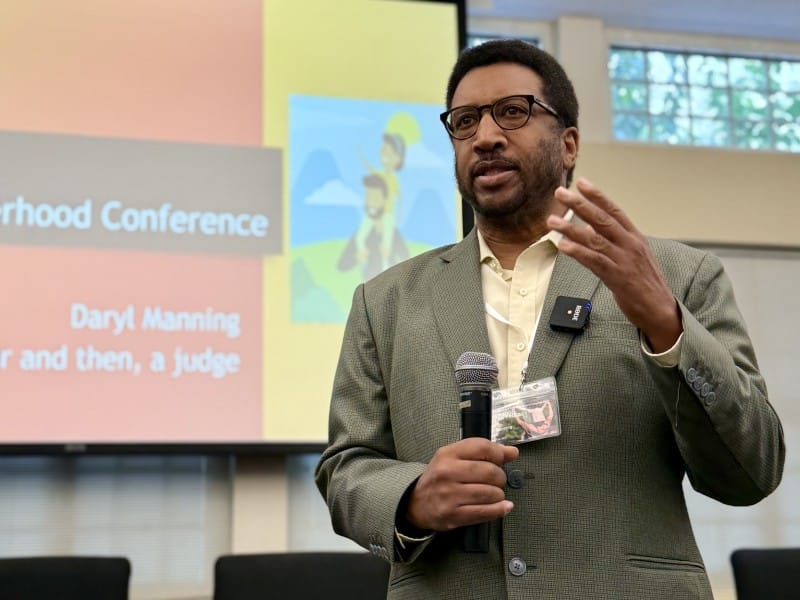
Affirming Fatherhood Conference offers insights into challenges facing today’s families
REACHUP says it wants to let fathers know that when they’re engaged, the outcomes in their families are much better.
ULI Tampa Bay launches two new leadership events
Two new ULI Tampa Bay events will bring together land-use and real estate professionals for regional tours, networking, and leadership development.

Art Everywhere launches in Pinellas this fall
Art Everywhere awarded close to 30 arts organizations a combined $350,000 in grants for events that can establish Pinellas County as a cultural destination.