Rock on! History Center extends popular guitar exhibit
“America at the Crossroads: The GUITAR and a Changing Nation” is at the Tampa Bay History Center through August 23.
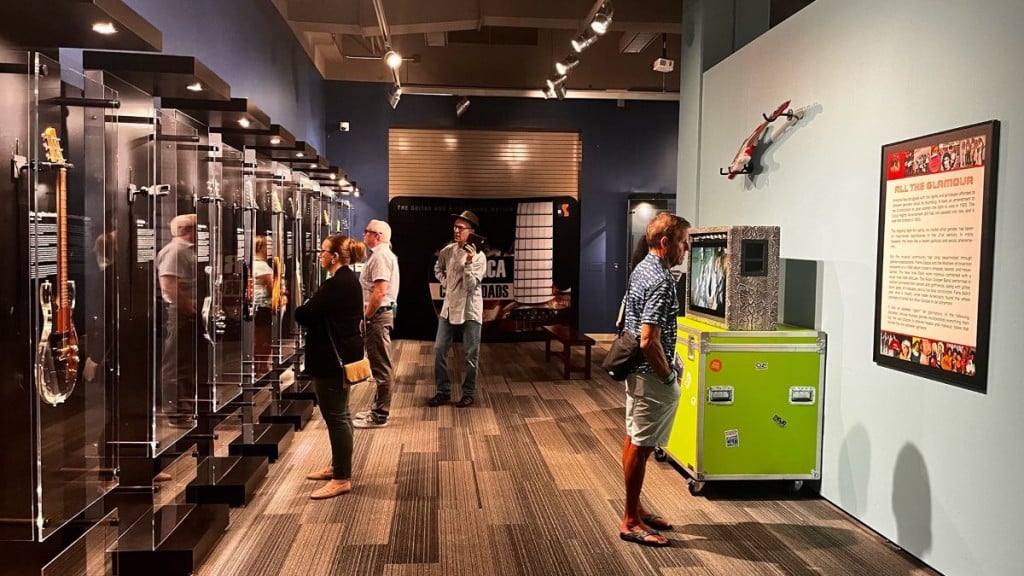
Due to popular demand, the Tampa Bay History Center has extended an exhibit spotlighting the guitar’s impact on America until August 23.
Initially scheduled to close May 3rd, “America at the Crossroads: The GUITAR and a Changing Nation” takes the visitor from an early version of the instrument brought to America by the Spanish explorers to the era of the electric guitar.
One of blues legend B.B. King’s “Lucille’’ guitars is on display. And in the lobby is a guitar signed by members of the Rolling Stones, on loan from the Columbia Restaurant’s Richard Gonzmart. But the show is not about individual performers. It focuses on the instrument’s development and symbolism through the years, says H.P. Newquist, founder of the National GUITAR Museum and curator of the traveling exhibit.
“The guitar has been part of American culture literally since the Spanish and the English arrived. They both brought stringed instruments with them, along with farm tools and guns,” says Newquist.
The instrument the Spaniards brought with them was the vihuela de mano, the forerunner of the guitar, which sounded more like a lute.
“It was the first stringed instrument that was ever played in the Americas,’’ Newquist says.
Only three original vihuela de mano instruments are known to exist, all in vacuum-sealed cases in museums. The one in the exhibit is a replica of one that was stored in Paris, Newquist says.
“We’ve got an exact replica of that, right down to the sheep intestine strings,’’ he says.
The exhibit showcases the guitar as a fixture in various social movements and cultural eras.
“You had people wandering the country playing folk songs in the late 1800s and early 1900s,’’ Newquist says. “You had the whole mystique of the Wild West and the singing cowboy, a cowboy heading out on the prairie or the plains on his horse in a cattle drive with a guitar slung across his back.’’
From the 1930s into the 1960s, it became a representation of protest played by traveling troubadours like Woody Guthrie, who painted “This machine kills fascists’’ on his guitar during World War II.
The exhibit also traces the blues and its transformation into rock ’n’ roll. The blues, as we recognize it, has been around since the late 1800s. It was a music “inspired by everything from gospel to folk songs, primarily in the South and most often played by sharecroppers and enslaved people living on plantations,’’ Newquist says.
The change came in the 1930s, ’40s, and ’50s, when small record companies began recording Black blues musicians, he notes. Blues musicians of the era mostly played acoustic guitar, and the recordings had a very limited audience, primarily Black audiences in the South and some in the Midwest. A lot of the records made their way across the ocean to Europe. In England, high school and college students began buying up the records during a mid-50s blues craze.
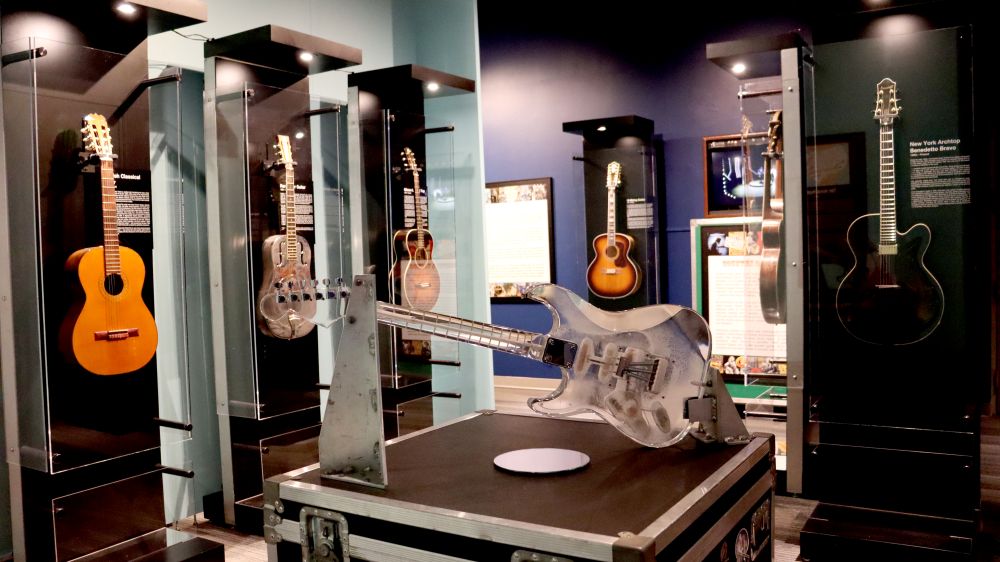
At the same time, the electric guitar was coming into its own. Many visitors to the exhibit are surprised to learn that Leo Fender, who designed the first mass-produced solid-body electric guitar and has his name on millions of electric guitars worldwide, never learned to play guitar, Newquist says.
“He couldn’t tune a guitar,” he says. “He was tone deaf.”
The electric guitar was the first instrument that baby boomers could call their own. When they played the blues on it, Newquist says, it really “electrified the whole thing’’ – in both meanings of the word.
British kids who’d fallen in love with American blues music started turning the electric guitar up loud.
“And by turning it up loud, their amplifiers and their guitars gave the blues kind of a heavy distortion sound,” Newquist says. “And people like Eric Clapton and (American) Jimi Hendrix created a heavier sound using standard old blues tunes that really appealed to British kids.’’
Though many people believe rock and roll started in the 1950s with Bill Haley and His Comets’ “Rock Around the Clock’’ and early practitioners like Elvis, Carl Perkins, and Jerry Lee Lewis, Newquist believes that the electric guitar was “the key element in creating rock and roll,’’ and true rock and roll was born when British bands started touring America in the 1960s.
“Some would characterize Jerry Lee Lewis and Little Richard’s styles of exuberant piano playing as being rock and roll, but to me they are really immediate precursors to rock and roll,’’ Newquist contends.
Newquist is an authority on artificial intelligence and the author of dozens of fiction and non-fiction books and numerous articles on the guitar and guitar industry. He also plays guitar.
“I grew up in the ’70s and like every kid who saw Led Zeppelin or Yes or Deep Purple, I wanted to be able to do that,’’ he says. “So I started playing guitar in high school through college and a little while after. I pursued that dream that every kid had of wanting to be a rock star guitarist, and that didn’t quite pan out.”
For more information and tickets, go to America at the Crossroads
Author

Related Articles
USF prof’s new poetry collection celebrates Florida’s daily rhythm
USF English professor Heather Sellers’ new poetry collection, “Women in Tampa Talking about Alligators,” is the final entry in a trilogy documenting her native Florida.
A new chapter for Tampa Bay’s independent bookstores
Across Tampa Bay, independent bookstores are making a comeback by offering a sense of place, distinct personality, and human connection that online retailers can’t match.
Art Everywhere launches in Pinellas this fall
Art Everywhere awarded close to 30 arts organizations a combined $350,000 in grants for events that can establish Pinellas County as a cultural destination.