Local hackers gather in Tampa to find solutions to problems of Bay Area homelessness
How to provide technical solutions to problems that confront the Tampa Bay Area homeless population? Invite local hacker volunteers to a 3-day event, called CodaPalooza, in observance of the National Day of Civic Hacking, sponsored in part by Code for America.
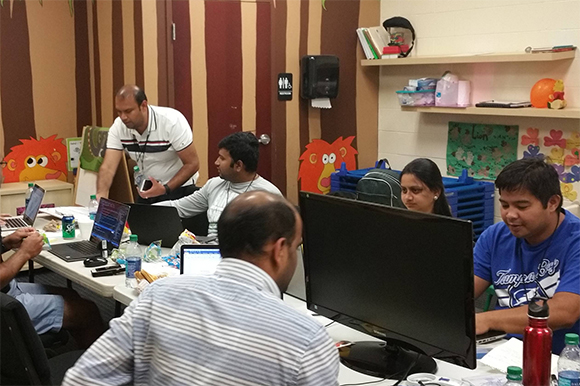
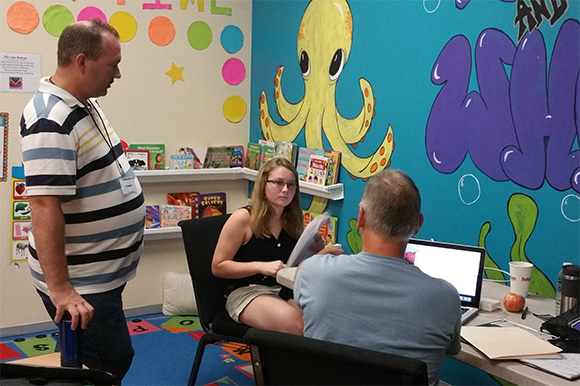
It’s Saturday night at the Crossover Church on Fowler Avenue in Tampa north of downtown. A Planet Grilled Cheese food truck is in the parking lot, behind a line of hungry volunteers who are waiting for hot sandwiches.
Inside the church gymnasium, there’s no band entertaining or choir practicing. What you hear are just the sounds of fingers striking laptop keys, and scattered conversations about programming languages. These are the sounds of Tampa’s creative class making a booming impact in the community and beyond.
From June 3rd to June 5th they gave their time and talent to Code for Tampa Bay’s yearly hackathon, a gathering of volunteer programmers working on “hacks” or “solutions” to civic problems.
This year’s hackathon was dubbed CodaPalooza: Gimme Shelter and was one of many nationwide events that coincide with June 4th, the National Day of Civic Hacking. The day was established in part by Code for America, a nonprofit that “organizes networks of people who build technology.”
In each city that participates, programmers and data scientists form “brigades,” with each working on tech that fosters the health, prosperity and safety of the community. The Code for Tampa Bay Brigade, which organized previous events with Hillsborough County, was joined this year by the Tampa Innovation Alliance.
Mark Sharpe, the executive director of the Alliance, says this is the first time the hackathon had one central focus. In past years, volunteers were able to choose civic problems that they wanted to tackle. But thanks to a suggestion from Hillsborough County’s CIO Ramin Kouzehkanani, CodaPalooza: Gimme Shelter took on one of the county’s most pressing issues: homelessness.
“No one’s in charge,” says Sharpe. “No one owns the problem or the solution. We’re all working collectively to try to come up with the solution. And the coders and developers are the glue that pull it all together.”
Listening to find solutions
The idea of a “hack for homelessness” generated a lot of excitement among sponsors, with some, like Tampa-based Bloomin’ Brands sending over a team of programmers in addition to financial support.
Students from the USF College of Engineering and School of Social Work, members of the Code for Tampa Bay Brigade, programmers from Accusoft and independent programmers also collaborated on teams.
Altogether about 40 coders participated, working on modules that they presented to a panel of judges on the final day. They received awards for the top three solutions and in special recognition categories.
“What’s cool about a hackathon like this is that you’re getting the talent you can’t pay for,” says Tracy Ingram, a consultant with the Alliance who served as the event’s emcee for the weekend.
Ingram spent six months talking to workers at the Tampa Hillsborough Homeless Initiative and other local agencies that support the homeless, to find out what was needed to improve Unity, the county’s centralized homeless data system, and several existing processes.
“You just have to stop for a second and listen,” Ingram says.
Listening helped inform the 10 modules that were presented to both the teams and a wider audience on GitHub, a space for open-source collaboration. In addition to working on modules, Ingram produced a video featuring agency workers and homeless individuals explaining many of the problems they face.
That video is how Craig Appel, a recently homeless veteran and former Hollywood stuntman, became involved. He was recruited by Ingram to tell his story on camera, which then led to helping edit the video, coaching teams on what it’s like to be homeless, and even judging the final projects.
Ingram says he would have never guessed that Appel was homeless when they met. He was trying to sell off movie props at his friend’s garage sale and offered a lot of backstory on each prop.
“He seemed to be good with people,” Ingram says.
He then noticed Appel’s change jar labeled with “Homeless Veteran,” and learned how his 20-year career in Hollywood, working on films that include “Pirates of the Caribbean,” “Planet of the Apes” and “Underworld,” ended when he suffered a serious accident. After moving to Tampa for a promised job that never panned out, he found himself homeless, living out of his car with his girlfriend and their one-year-old daughter. A month passed before he was able to secure a hotel room, followed by a voucher for a home, with the help of Ingram and others involved in the event.
“Being homeless with a child is the worst thing you can ever imagine,” Appel says. “It really pulls on your heart strings.”
It takes a dedicated team
Ingram says that Appel made an important contribution to the teams’ efforts.
“We have a lot of people who know how to do a form or an app, but who don’t understand the frustration of situations like having your phone die when you’re trying to call places to find a shelter,” he says.
Appel was able to keep his smartphone during his hardship, like the estimated 85 percent of homeless individuals who either own or have access to one. But even with Internet and additional resources that are available to veterans, he still struggled to navigate red tape and get help for his family.
Armed with this knowledge, the Bloomin’ Brands and USF teams focused on making mobile apps that are easy for the homeless to use. While existing websites overwhelm the homeless with lists of all the shelters and food kitchens in the entire county, what is really needed are shorter lists of agencies in a nearby area. Both teams knew they wanted to incorporate GPS to accomplish this, and also included filters to distinguish shelters for domestic violence victims, pregnant women and veterans.
The Code for Tampa Bay Brigade similarly developed a solution that works with cell phones, only theirs is a web app that sends text message alerts. These text alerts can notify a caseworker if a homeless person is in trouble, and also inform a homeless person of an approaching court date.
“If they are arrested and end up with a court date, a notice will be mailed that doesn’t reach them, since they’re homeless,” says programmer Mike Turtora. “Then they’re in contempt of court and end up with a Writ fine, which as time passes will accrue interest. The next thing they know there’s a warrant out for their arrest and they wind up in jail again. This creates a cycle of going to jail.”
“Homelessness is criminalized,” says Ingram. “Really if you think of how many people are living paycheck to paycheck, it’s not right that there is such a stigma attached to being homeless.”
Keeping the solutions coming
Accusoft’s team created a web app to collect data for the Point-In-Time Homeless Count Survey, eliminating the need for volunteers to go out with stacks of paper forms to survey the homeless and then later having to type the information into a database.
Antonio “Tony’’ Byrd, the COO of the Homeless Initiative, had expressed how labor-intensive it is to train 350 volunteers to consistently collect data. The team’s new app not only reduces the number of volunteers that are needed, but also allows for survey questions to be modified easily.
“There is the problem of the illumination of noise,” says Programmer Jeremy Smith. “People end up filling out forms with data that isn’t really relevant.”
The ability to change the surveys means that homeless individuals will no longer have to waste time answering pre-printed questions that don’t pertain to them.
Teams of independent programmers took on the automation of forms for the Florida Marchman Act, and researched a new homeless data system to centralize all the data and tell the comprehensive story of any given homeless person.
Steven Brown says his motivation for continuing to work on the centralized data system involves reducing redundancy.
“The idea that a piece of data is recorded in multiple places is to me the epitome of inefficiency, and I hope to fix that,’’ Brown says. “In the end, I think that one reason that people don’t get the most out of technology is that it is inefficient and hard to use. If we eliminate that barrier, then we eliminate the barrier to more widespread adoption.”
CodaPalooza may be over, but the tech initiatives to solve problems of homelessness are just beginning.
Sharpe, of the Alliance, has asked the teams to continue working on their solutions to present at the next major showcase of tech talent, the Innovation Gathering on October 26th.
“[Gimme Shelter] is just a launch point to get people excited,” says Programmer Arthur Alton.
Sharpe also emphasized that he wants to make this a year-round effort, and he’s not the only one. The USF team, for example, has a four-phase plan for further development and deployment of their solution, which could find use outside of Tampa Bay.
“It’s exciting that developers realize that this has the potential to be spread to other states and communities to address the issue all over,” says Ingram.
Sharpe tends to agree. “We’re going to take this thing all over the country.”
Author

Related Articles

Tampa Bay back-to-school supply drives, giveaways
Back-to-school supply drives and giveaways provide crucial resources to the Tampa Bay region’s economically disadvantaged students and families.
Community Foundation Tampa Bay grants support record number of nonprofits
This year, Community Foundation Tampa Bay awarded a record more than $2.5 million in competitive grants to 88 nonprofits.