USF Bellini College associate dean shares AI insights
USF’s Lawrence Hall discusses current state of AI and looks to the future.

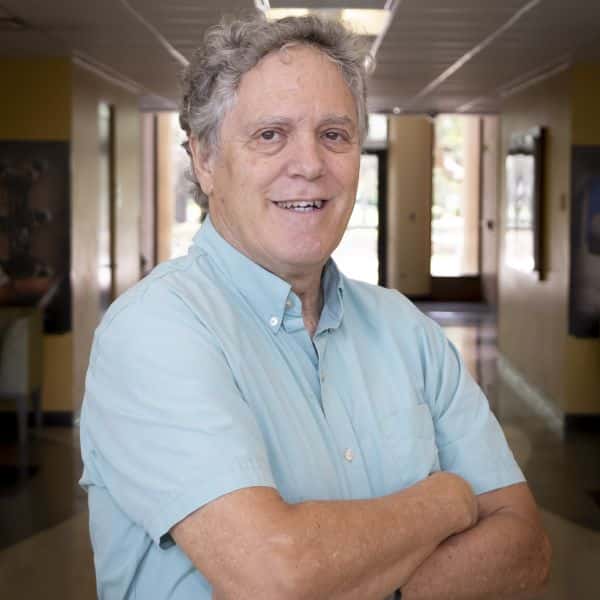
University of South Florida faculty member Lawrence Hall has been researching artificial intelligence for 40 years. Based on his experience, he offers some reassuring words. We don’t have to worry right now about AI turning into HAL 9000, the mad, murderous computer in the sci-fi classic “2001: A Space Odyssey’’ that starts killing astronauts out of paranoia they will jeopardize the mission to Jupiter.
There’s no threat that the current versions of AI will develop consciousness, says Hall, Associate Dean of Research Innovation at USF’s recently established Bellini College of Artificial Intelligence, Cybersecurity and Computing.
However, it’s hard to say that about the distant future, he adds. That’s why it’s vital that scientists put safety barriers in place as they build these systems.
“I think that having guardrails there makes sense, just in case we build something that can become conscious,” Hall says. “Because if it does, it may generate its own desires.’’
He says the key benefit of AI is its potential to make people more productive by handling time-consuming repetitive functions for us.
“I mean, there are lots of tasks that we do that are kind of repetitive,” Hall says. “Think about just working to produce a figure from a spreadsheet.”
Now, you can give AI the information, and “boom,” it will produce the figure for you, he says.
These days, just about everyone encounters AI. If you ask Siri a question on your cell phone, AI understands the question and searches the sources programmed into it for the answer, Hall explains. Currently, AI completes simple tasks for us, Hall says. For example, he says he’d feel comfortable asking AI to book an Uber ride. But he’s not comfortable asking AI to buy an airline ticket at the best price available.
“Say I want aisle seats. It ignores that, but will get me a price 100 dollars cheaper. It sits me in the middle and takes five hours longer. So I save 100 dollars, in the middle, five hours longer. I’m going to miss my meeting now, but I did save 100 bucks,’’ he says, wryly.
Hall says he and his students have asked large language models such as ChatGPT and Gemini the same question in a slightly different way, perhaps by using a synonym for a word in the original question, and gotten “a completely different answer.’’
He expects these issues will be resolved in the future. Right now, they show the danger of relying too heavily on AI.
“If I’m pretty sure that it makes sense and is right, I might use it, but I’m going to be skeptical of anything it gives me,’’ Hall says. “I think if you rely on it too much, you may have problems.’’
For example, Hall used AI to create computer code, and the code it generated wasn’t secure. And the key to cybersecurity, he says, is training people to create secure code and update it routinely.
One problem teachers routinely deal with these days is whether a student’s paper was written by AI.
“Generally, I think that I can tell when something is AI-written, because it’s so perfect in places and the phraseology that it uses is pretty much always the same,’’ Hall says.
Serving on a committee that reviews scholarly papers, he addresses the issue regularly.
“One of the things we have to concern ourselves with is whether a paper was written by a human or by AI or both,” Hall says. “We ask people to disclose what was what.’’
Teaching a class, he worries that a student will be assigned to write a program and have AI do it.
“Then, what did they learn?’’ Hall says.
For more information, go to USF Bellini College
Author

Related Articles
St. Pete school Indi-ED reimagines education around real-world skills
Indi-ED’s St. Pete Standout youth leadership competition connects 100 Bay Area students with business and community leader mentors.
Community Foundation Tampa Bay looks to build on record year for scholarships
In 2025, Community Foundation awarded more than 550 scholarships and over $2 million.
USF prof’s app targets mosquito habitat, fights tropical diseases
USF College of Public Health associate professor Benjamin Jacob has developed a potential game-changer in the fight against tropical diseases – a smartphone app that quickly locates and identifies mosquito breeding habitats so they can be targeted, treated, and destroyed.