Striving for seamless social service system in Tampa Bay
Area nonprofits like Feeding Tampa Bay and Crisis Center of Tampa Bay are weaving a more connected safety net.
To the casual observer, nonprofits like Feeding Tampa Bay and the Crisis Center of Tampa Bay serve specific needs. One addresses food insecurity among those who cannot afford healthy, fresh food; the other administers the suicide helpline and helps those facing sexual or domestic violence and mental health challenges.
In reality, the two nonprofits aren’t solving isolated problems, they’re helping the same people at different points along the same path.
And the need continues to grow.
A system hiding in plain sight
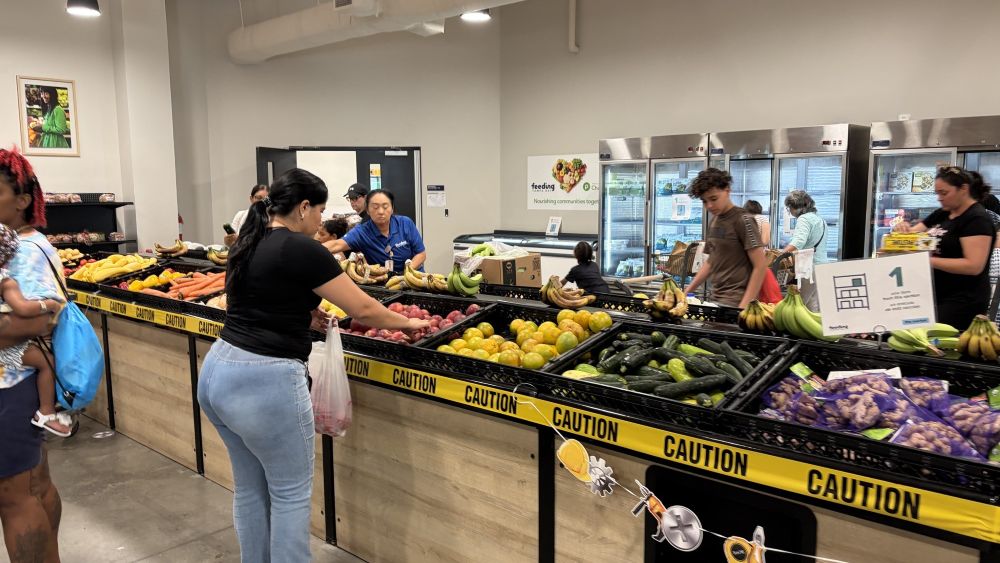
At Feeding Tampa Bay’s Causeway Center, neighbors (their word for patrons) shop in a free grocery store. They check out, but they don’t pay. Afterwards, they can order items like a strawberry salad or chicken panini for lunch at The Bistro, a payment-optional restaurant.
Next door, they can meet with community partners — an onsite health clinic with a doctor, nurses, and licensed social workers; representatives from Tampa Electric, Suncoast Credit Union, and Metropolitan Ministries; and other organizations offering help with utility bills, financial planning, and housing.
It is seamless by design so people don’t fall through the cracks.
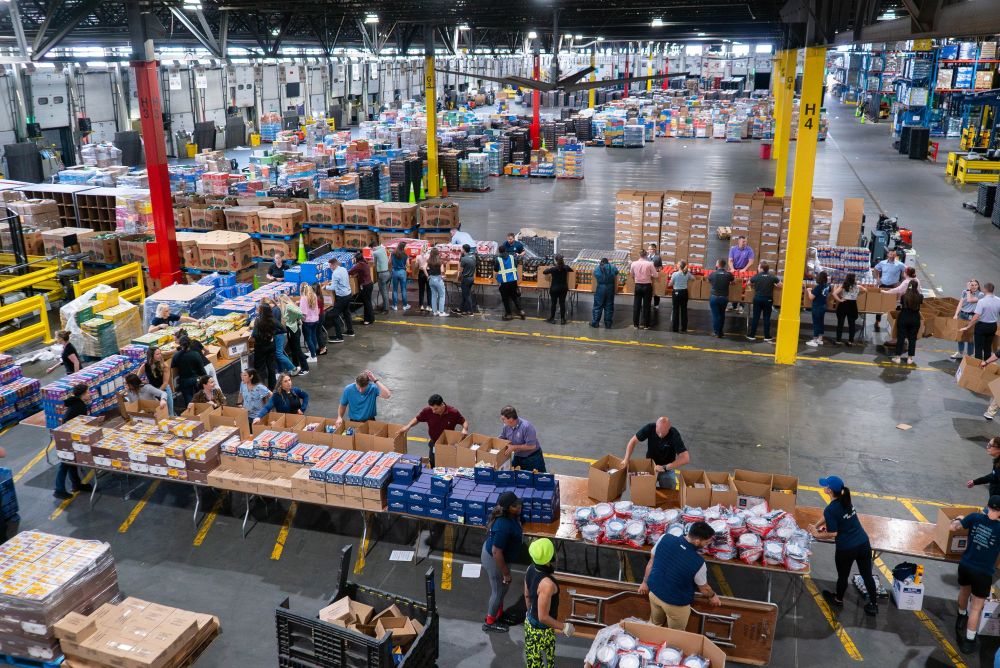
Inside the warehouse, the scale of the operation is more apparent. Pallets of produce and pasta move in and out with the efficiency of a distribution hub. The operation runs with the precision of a business because when you’re serving 80 million meals a year across a ten-county region, inefficiency isn’t an option. The food is sourced from traditional grocery suppliers and partnerships with farmers and producers across the state. Programs like Farmers Feeding Florida redirect surplus dairy, beef, eggs, and produce into the hands of families who need it, turning what might have been waste into stability.
Changing times
For decades, food banks were designed to respond to hunger as a discrete problem. Feed people, and you’ve done your job. Over time, Feeding Tampa Bay began to see that hunger rarely happens in isolation. It often coincides with job loss, rising housing costs, medical bills, and childcare gaps. By the time someone walks through the door in search of help, they’re often dealing with several of these challenges.
“You do this work long enough, you start to see the patterns,” Feeding Tampa Bay CEO Thomas Mantz says. “We’re not getting ahead of the problem—we’re holding the line.”
Over time, the organization expanded to meet the needs of the people it serves. Conversations with neighbors, partners, and policymakers birthed the idea for the Causeway Center, a 215,000 square-foot complex where multiple needs can be addressed in a single visit.
The breaking point
Across town, the Crisis Center of Tampa Bay is where people turn in times of trauma and turmoil.
Through its 211 helpline and network of services, the nonprofit fields nearly 300 calls a day and supports people facing everything from suicidal thoughts to housing instability to substance use.
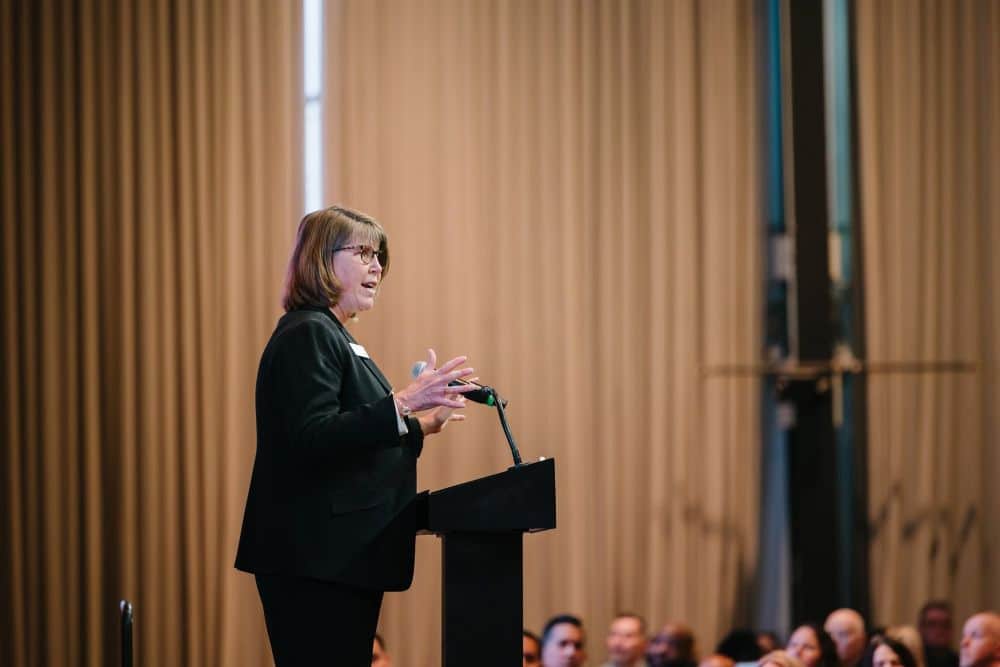
“It’s usually that one thing that pushes them over the edge,” says Crisis Center CEO Clara Reynolds.
For a caller named Shannia, that moment came after a sexual assault.
She had called the Crisis Center before during difficult periods, but this time her emotions were harder to manage.
“Everyone was really supportive,” she says. “They stayed on the phone with me for an hour, and made sure I was safe before we hung up.”
In the weeks that followed, the Crisis Center’s advocacy program staff helped guide her through the legal process, including giving statements and appearing in court. Advocates accompanied her, helped her build a safety plan, and stayed in close contact throughout.
“They’ve been there emotionally, mentally, and physically,” she says.
The experience reshaped her understanding of what support could look like. It’s a shift Reynolds sees frequently. She knows these challenges do not exist in silos. Mental health crises are rarely just about mental health. They’re connected to financial stress, food insecurity, unstable housing, and trauma that may have gone unaddressed for years. People don’t arrive with a single, cleanly defined problem. They arrive after a series of small failures — personal, financial, systemic — that finally converge into “I can’t take it anymore.”
That convergence has shaped how the Crisis Center operates. Beyond crisis response, the organization has developed care coordination services to guide people toward the right support at the right time.
“The difference between us and Google,” Reynolds says, “is that people don’t always know what the real problem is. They think the symptom is the problem.”
Shannia was hesitant to call.
“People think the police will be called right away, or that they’ll get in trouble,” she says. “That’s not how it works. The advocates listen. They help you make a plan. They stay with you.”
She has a message for other survivors:
“You’re not alone,” she says. “There are people who will be there for you, even if you don’t know them yet. It’s not your fault, and what happened to you — you did not deserve it. You are stronger than you believe.”
Taken together, organizations like Feeding Tampa Bay and the Crisis Center are not individual nonprofits but parts of an emerging system that connects food, health, financial stability, and crisis response in ways traditional structures often do not.
In recent years, the gap between need and available support has widened, driven by rising costs and uneven access to services. Nationally, philanthropic leaders have been clear about the limits of private giving. Even in moments of extraordinary coordination, charity cannot replace the scale of public investment. As one NPR analysis put it, “the math doesn’t work.”
That stress is visible locally.

Feeding Tampa Bay now serves more people than ever before, including many individuals who are employed. Data from the United Way’s ALICE report shows that a growing share of households are working but still unable to consistently meet basic needs. ALICE (Asset Limited, Income Constrained, and Employed) households have an income above the federal poverty level but below the basic cost of living in their county. Between 2010 and 2023, the total number of households in Florida increased by 27 percent, the number of households in poverty by eight percent, and the number of ALICE households by 31 percent.
The stability budget for a family of four in Florida, including 10% for savings and emergencies, is more than $116,000, while the median household income is about $75,000. Cost inflation across categories has outpaced wage growth.
“When you talk about economies, you’re either feeding your customers or your colleagues,” Mantz says “We have to move past the moral argument and ask how we build more capable communities.”
Support in crisis
Business owners see it up close.
Blind Tiger Coffee Roasters founder and Feeding Tampa Bay board member Roberto Torres sees his employees and customers navigating the same set of challenges. To him, the nonprofit and for-profit worlds are not as distinct as they might appear.
“They’re both businesses,” he says. “They’re both trying to make something work.”
What he sees, increasingly, is not just financial strain, but something harder to measure—pride, stigma, the quiet erosion of confidence that comes with needing help in the first place.
“A lot of the battle is in people’s minds,” he says.
For individuals living close to the edge, small disruptions can have outsized consequences. A missed paycheck, a medical bill, a spike in rent can set off a chain reaction that leads someone from relative stability into crisis.
Organizations like Feeding Tampa Bay and the Crisis Center are designed to interrupt that chain reaction. One provides food, access, and upstream support. The other meets people at moments of acute need and helps guide them back toward stability.
Between them, they form a kind of connective tissue holding together a system that might otherwise remain fragmented and impossible to navigate.
The system’s limitations
Still, there are limits to what that connective tissue can bear. Reynolds is watching the horizon with concern.
Proposed property tax reform at the state level, specifically HJRs 201 and 203, could reduce Hillsborough County revenues by up to $2.2 billion annually, according to Florida’s Revenue Estimating Conference. That reduction would impact the county funding social service agencies depend on.
The federal grants that nonprofits long relied on have been eliminated. Tallahassee is facing its own budget pressures. All of it is converging at the same moment demand is rising.
“Every donor could double their donation and there’d still be challenges to meet the need,” Mantz says.
Torres says nonprofits alone will never be able to fill that gap.
One possibility Reynolds sees emerging is consolidation — nonprofit organizations merging to achieve the kind of operational efficiency that individual budgets can no longer support. It’s a significant structural shift for a sector built around mission-driven independence. But it’s also an area where the Crisis Center has experience. At the beginning of 2025, it absorbed fellow nonprofit Success 4 Kids & Families through a merger.
When It works
On any given day at the Causeway Center, neighbors move from one service to another, picking up groceries, meeting with a financial counselor, and sitting down for a meal. At the Crisis Center, people trained to listen first and act second help callers who feel overwhelmed take the next step.
In a region that does not always function as a single, unified system, these organizations are attempting to create a structure that does. Reynolds believes success would look deceptively simple.
“It would be effortless,” she says. “You’d know where to go. There would be no wrong door.”
People would seek help before they are hanging on by a thread. Services would connect more seamlessly. Fewer individuals would fall deeper into crisis simply because they didn’t know where to turn. It’s an aspirational vision, and one that depends on alignment across sectors that have not always moved in sync.
For more information, go to Feeding Tampa Bay and Crisis Center of Tampa Bay
Author

Related Articles
Comprehensive approach to improving early literacy producing results
Thrive by Five is a collaborative effort to reach families and children and improve school readiness. The goal is to have 65 percent of children ready for kindergarten by 2030.
Hillsborough Children’s Services, TPA turn unclaimed luggage into Duffels of Dignity
Tampa International Airport has partnered with Hillsborough County Children’s Services’ Duffels of Dignity program to donate unclaimed luggage to foster youth and at-risk children.

Partner Partner Content JWB’s Turbo Babies supports parents as their child’s first and best teachers
Turbo Babies offers families free “Pit Crew” bags filled with books, toys, and brain-building activities because 80 percent of brain growth occurs in the first three years of life.