New historic marker honors Temple Terrace orange grove history
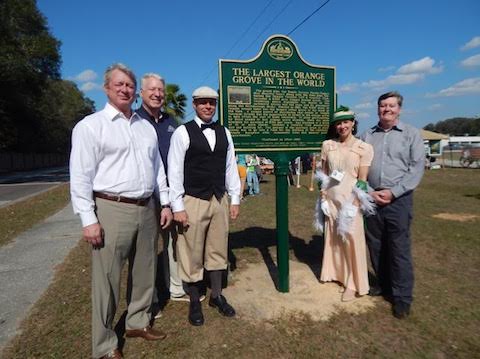
Temple Terrace leaders and historic preservationists are honoring the orange grove with an historical marker at the corner of Gillette Avenue and East 113th Avenue, next to the Greco Middle School.
Even many Temple Terrace residents may not know that their charming little city surrounded by Tampa was named after an orange.
A 5,000-acre temple orange grove planted in the 1920s gave birth to the city named Temple Terrace. The grove, which included land now occupied by Busch Gardens, the University of South Florida and parts of Temple Terrace, was proclaimed the largest orange grove in the world.
Now city leaders and historical preservationists are honoring the orange grove with an historical marker at the corner of Gillette Avenue and East 113th Ave., next to the Greco Middle School track. A ceremony in early February also celebrated a “mini-grove” of temple oranges planted by Greco students.
Elisabeth Leib, a board member of the Temple Terrace Preservation Society, is also involved with Greco’s Farm 2 School program and helped initiate the mini-grove project.
“We had this large orange grove and our mission is to advocate for local history,” says Tim Lancaster, President of the preservation society. “So, at the same time we dedicate this marker, we’re kind of reliving that history by putting these new orange trees in the ground.”
This will be the fifth marker the preservation society has placed around the city of 22,000.
Temples are regarded by many orange enthusiasts as the tastiest variety around. The orange has a soft and spongy exterior with a shiny, pocked peeling that’s easily removed. The segmented fruit is loaded with juice and has a slightly tart taste that explodes on the palate.
A variety of a tangor — a cross between the mandarin orange and the sweet orange — the Temple is believed to have come to Florida from the West Indies early in the 20th century, according to an article in the New York Times. The orange was named for William Chase Temple, a prominent grower and owner of the Pittsburgh Pirates.
Lancaster says D. Collin Gillette, one of the original developers of Temple Terrace and its first mayor, was heavily involved in the citrus industry in the 20s. To attract investors, the mayor’s company allowed people who bought property in the city to buy shares in the orange grove.
“You could use proceeds from the orange grove to pay of your real estate investment,” Lancaster says.
The World’s Largest Orange Grove marker is Temple Terrace’s 5th. Others include Spanish Exploration of Temple Terrace at Riverhills Park, Bertha Palmer at Woodmont Clubhouse, Billy Graham at Billy Graham Park, and Sutton Hall (original clubhouse of Temple Terrace Country Club) at Florida College.
Author

Related Articles

Enterprising Latinas empowers Hispanic women in Tampa Bay
Wimauma-based nonprofit creates pathways of opportunity for Latinas in the Bay Area.
Tampa’s Parking Community Garden blooms with purpose
Tampa has transformed underutilized space outside the Whiting Street garage into a community garden.

Masthead gallery: Lakeland Downtown Farmers Curb Market
A photo gallery from the Lakeland Downtown Farmers Curb Market