Fresh tactics on transit in Tampa Bay
Tampa City Council’s pragmatic approach for improving service and growing ridership on HART Route 1 is producing results.
“We’re at an inflection point for public transit,” says Tampa City Council member Lynn Hurtak.
For decades, the story has been that Tampa was not dense enough, compact enough, or urban enough to support meaningful public transit. The region grows outward, not upward; cars are a static fact of life here.
And yet, this narrative ignores our own history. Long before Tampa became accustomed to measuring distance by drive time, streetcar lines connected neighborhoods far beyond the downtown core. Robust public transit wasn’t an afterthought; it was an organizing principle. The bones of that system are still visible if you know where to look.
Transit's time
As growth accelerates and the city builds vertically rather than horizontally, the strain on our roads, bridges, and household budgets becomes impossible to ignore. Without viable alternatives to driving, mobility itself becomes a bottleneck.
Many roads are already in disrepair, and the costs to maintain them will only increase. What’s more, building additional road capacity doesn’t ease congestion; it induces demand, according to the national nonprofit Transportation for America.
Hurtak says we’ve now reached the point where developing better transit service in Tampa and across the region is not optional.
“Public appetite for hybrid solutions is growing,” she says. “No one is asking for transit absolutism.”
That pragmatism is already on display on Tampa’s streets.
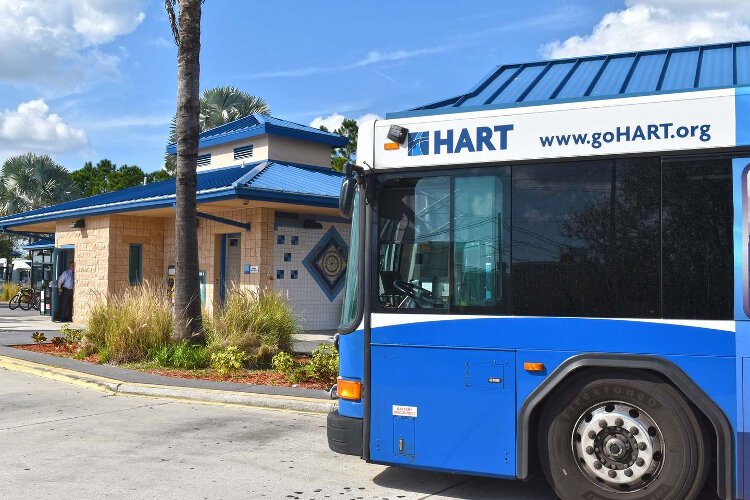
From January 5, 2025 through January 4, 2026, the Tampa City Council funded a pilot project that made the Hillsborough Transit Authority’s (HART) Route 1 fare-free for a year. Route 1, HART’s busiest route, connects downtown and the TECO Line Streetcar system to the University of South Florida, the VA hospital, and the University Area neighborhood.
The impact was significant. The route’s year-to-year ridership increased by 45 percent, according to HART. It wasn’t just the free fare fueling the spike in ridership. HART Director of Planning and Scheduling Heather Sobush says improved frequency — the simple assurance that another bus is coming soon — played a significant role. From 6 a.m. to 6 p.m. on weekdays, service increased from every 20 minutes to every 15 minutes.
While fare-free service is over, the City of Tampa continues to fund 15-minute weekday service on Route 1. The city is also funding additional frequency enhancements this year, improving service levels from 30 minutes to 20 minutes between 6 p.m. and 9 p.m. on weekday evenings and 6 a.m. to 9 p.m. on weekends. Those changes are in place through January 2027.
Pilot programs like Route 1 can do more than boost ridership in the short term. They can attract non-transit users and help them get accustomed to using public transit. In doing so, they demonstrate how modest, targeted investments help reshape how a city moves.
During a November 2025 HART Board of Directors meeting, Hurtak says the goal is to improve service on Route 1 every year until it reaches the state-mandated 6,000 passengers a day threshold for bus rapid transit to be a possibility along the corridor.
A different conversation
Tampa’s transit conversation has been long and frustrating. Since the late 1980s, the region has cycled through studies, demonstrations, and one-off ideas like elevated trams and conceptual rail lines. They often generated headlines but rarely sustained commitment.
Unlike past transit efforts, the Route 1 pilot came with a start date, an end date, a funding source, and a clear set of metrics, a rare thing in a region more accustomed to studying transit than testing, operating, and optimizing it.
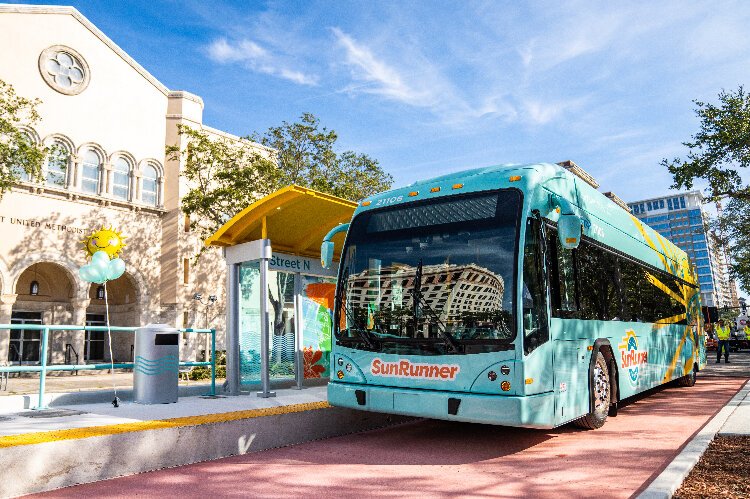
There are two notable exceptions. Launched in October 2022, the Pinellas Suncoast Transit Authority’s SunRunner bus rapid transit system connecting downtown St. Petersburg and St. Pete Beach, surpassed the 2.5-million passenger milestone by its third anniversary.
The TECO Line Streetcar launched in 2002 and, for years, functioned largely as a tourist attraction. Then, major redevelopment projects along the route reshaped Tampa’s downtown and the Channel District. Today, the 2.7-mile streetcar system remains fare-free with funding from Tampa’s Community Redevelopment Agency and links several of the city’s busiest and most desirable neighborhoods, downtown, Water Street, the Channel District, and Ybor City, with a future stop planned at the mixed-use Gasworx district. The streetcar hit 1.3 million annual riders in 2024.
A growing need in growing Tampa
The need for better transit grows with the population as Tampa’s urban core gains residents at a striking pace. In the 33602 zip code, which encompasses downtown, the Channel District, Tampa Heights, and Harbor Island, the population is projected to increase by 25 percent between 2021 and the end of 2026.
Transit advocate Dayna Lazarus, who has been working on these issues for more than a decade, says the conversation today is fundamentally different than 10 years ago. The focus has shifted away from sweeping, all-or-nothing megaprojects and toward practical improvements: increased frequency, fare-free pilots, bus rapid transit corridors that work within existing streets. These are transit improvements that meet people where they are.
Hurtak sums up the situation with a message that is less a slogan than a recognition of reality.
“The time for transit,” she says, “is now.”
For more information, go to HART
Author

Related Articles
Florida Bicyle Month events roll through Tampa, Dunedin
Take guided rides through the Westshore District and downtown Tampa or head to a bike safety event in Dunedin.
Slowing down Ybor City’s Seventh Avenue
Tampa officials unveil safety improvements on Ybor’s Seventh Avenue following high speed chase and crash that killed four.
Safe, scenic way to bike across Tampa Bay
The Howard Frankland Bridge shared-use trail and a pedestrian overpass on Pinellas side of Courtney Campbell Trail open this year.