Clearwater turns surplus properties into redevelopment opportunities
Clearwater is marketing dozens of surplus city parcels with strong redevelopment potential.
The City of Clearwater has a game plan to unleash the redevelopment potential of vacant and underutilized city-owned parcels.
As part of a city surplus property strategic initiative launched earlier this year, city staff has identified several dozen City of Clearwater and Clearwater Community Redevelopment Agency-owned parcels that no longer have a municipal use, but do have the size, zoning, and location to be good candidates for redevelopment. Clearwater has ramped up efforts to market the properties to developers and investors to attract development proposals that put the parcels back on the tax rolls, breathe new life into the properties, and help revitalize neighborhoods, while aligning with city goals such as economic development, affordable housing, and job creation.
“Fundamentally, the city wants to get out of the ownership business,” says Assistant City Manager Alfred G. Battle Jr. “This is one way to do that. We’re doing this to encourage and solicit development. From a strategy standpoint, we’re trying to be very proactive and aggressive in the redevelopment and investment in the City of Clearwater.”
The majority of the surplus properties Clearwater is marketing are within the city’s Downtown and North Greenwood Community Redevelopment Area districts and are part of larger strategies to revitalize and reenergize those areas.
Clearwater Mayor Bruce Rector says he’d like to see private property owners get involved and take the effort to redevelop and revitalize citywide.
“I see this as the city leading our community as a whole,” Rector says. “At first, we’re taking a look at city-owned properties. But I hope it inspires the entire community, including private property owners who either have vacant property or properties that aren’t prospering to do the same. I really hope by the city taking action on these properties we will have the rest of the community looking at what we can all do together to make Clearwater shine brighter than ever.”
Redevelop, revitalize, reenergize
At the direction of the City Council, which also serves as the Board of Trustees for the city’s Community Redevelopment Agency (CRA), city staff evaluated more than 400 parcels, identifying 85 that have the size, zoning, and location to be good candidates for redevelopment. Phil Kirkpatrick, who oversees Business Recruitment and Property Development for the Economic Development and Housing Department, conducted the evaluation with input from city department heads. Some of the parcels were already on a state-required list of properties available for the development of affordable housing, which leaves approximately 70 parcels in the mix to potentially be sold as surplus and redeveloped for additional uses.
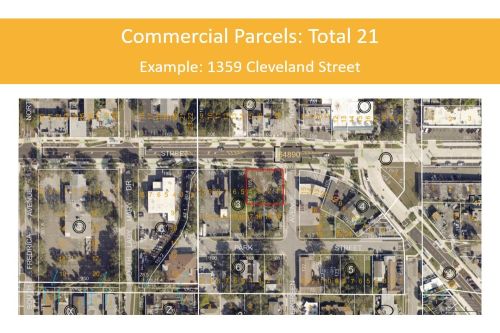
Some examples include a cluster of four parcels near the downtown waterfront to the south of the site of The Bluffs redevelopment project; two parcels on a high-visibility wedge of land bounded by Chestnut Street and Court Street downtown; and four vacant commercial properties west of DeLukas Restaurant & Bar on Cleveland Street in the Downtown Gateway District.
In the southern section of the Downtown Community Redevelopment Area, there are seven residential properties between Martin Luther King Jr. Avenue and Washington Avenue, north of Gould Street and south of Pierce Street.
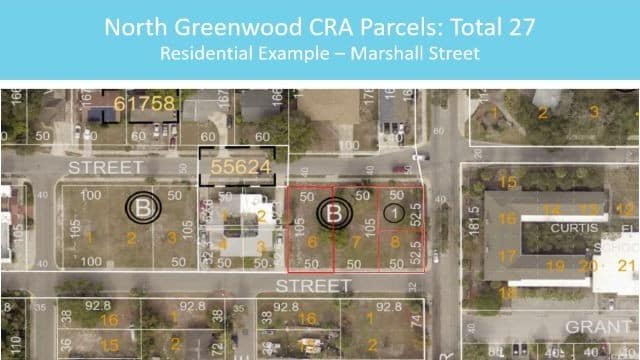
There are several residential lots in the North Greenwood Community Redevelopment Area that would be ideal for a developer to build single family homes or a duplex on a single lot. These parcels may also be of interest to a community non-profit for affordable housing. They include four adjacent parcels on Marshall Street west of MLK and east of the old Curtis Elementary School campus, which houses the Curtis Museum of Pinellas County, formerly the Pinellas County African American History Museum.
But Kirkpatrick, a former commercial real estate development manager, says the parcels are also an example of an opportunity to bundle small, adjacent parcels and assemble a larger development site to build something of greater scale, such as an apartment community. Likewise, two commercial parcels on Engman Street just west of MLK could be bundled and purchased together for development possibilities that include retail, mixed-use, office, and medical, he says.
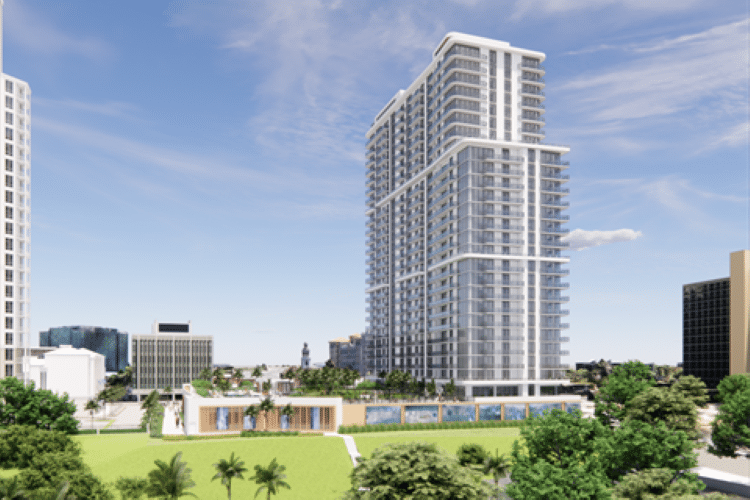
Downtown also has multiple opportunities to assemble larger development sites from a group of adjacent parcels. They include four parcels across Pierce Street to the south of where the Gotham Organization will develop a 400-unit luxury apartment tower with retail on the old City Hall site as part of The Bluffs redevelopment project. Just south of Clearwater Main Library, the DeNunzio Group is developing a 158-key Hilton Tapestry property, the Harborview Hotel, on the site of the former Harborview Center as part of that waterfront redevelopment project overlooking the rebuilt Coachman Park.
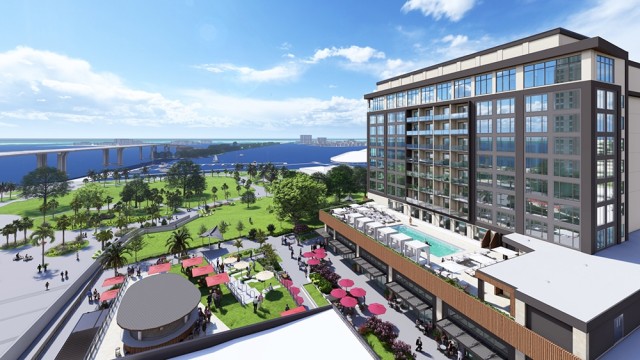
The Bluffs is a prime example of a redevelopment project on former city-owned surplus property, with one significant difference from the current process. Because the two former city properties that make up The Bluffs are located north of Pierce Street and west of Osceola Avenue, the city charter required approval in a voter referendum for the sale and project to move forward. That requirement does not apply to the four parcels the city is now eyeing for redevelopment because they are south of Pierce.
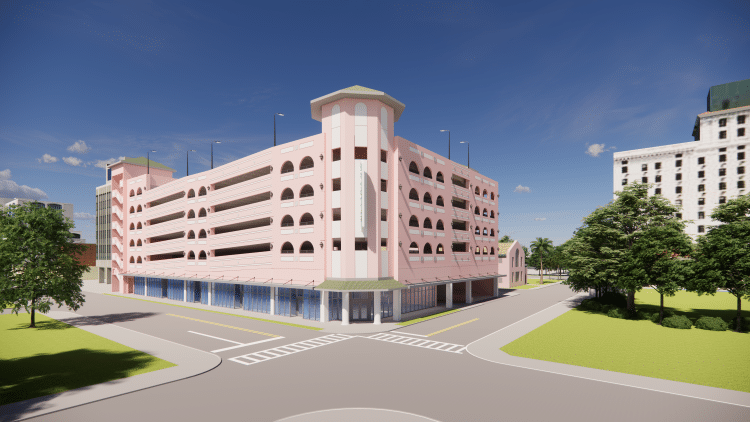
Kirkpatrick says bundling the four parcels together for a single site and building up would allow a developer to build to a higher density and more efficiently. In Clearwater’s downtown, developers can also receive density bonuses for projects that include features such as Class A office space, Leadership in Energy and Environmental Design (LEED) gold certification, or community public space. The four parcels are also a short distance from the site of a future 397-space city parking garage with opportunities for ground-floor retail/restaurant that’s being built at the corner of Osceola and Pierce.
Discussing some other surplus parcels downtown, Kirkpatrick says two city-owned parcels on a grassy island of undeveloped land bounded by Court and Chestnut are, to an extent, currently being used for stormwater collection and retention.
“It’s very valuable land to be using for stormwater,” he says.
Kirkpatrick says a developer who can acquire a third, privately held parcel on that wedge of land, and either build a new stormwater management structure or connect to the regional stormwater retention pond at Prospect Lake Park, would have an excellent site for a project.
“That is a great candidate for redevelopment,” he says.
In the Downtown Gateway area, Kirkpatrick says four parcels bordered by the Cleveland Street corridor to the north, Park Street to the south, and east of Evergreen Avenue, could be grouped for a mixed-use development such as multi-family residential over ground-floor retail.
In the south area of the Downtown CRA, he says seven residential parcels north of Gould Street and bounded by Martin Luther King Jr. Avenue to the west and Washington Avenue to the east could be bundled to assemble an approximately three-acre site for development such as an apartment community.
Process and procedure
The city is taking a phased approach to marketing the surplus properties, soliciting development proposals over time by grouping adjacent and neighboring parcels together and sending out a call for letters of interest from developers. Purchase offers and development proposals can focus on a specific parcel or bundle parcels to assemble a single site. The city plans to send out a solicitation for the commercial properties along the Cleveland Street corridor in the Downtown Gateway area next.
Community Redevelopment Agency Executive Director Jesus Niño and Battle Jr., the assistant city manager, say the disposition and sale of city-owned properties will follow the processes and procedures set out in the city charter, align with the city’s economic development goals, and be for the highest and best use, which may be the benefit of the community at large. For CRA-owned properties, the disposition process has to follow the Florida Redevelopment Act and the goals and objectives of the CRA plan for that area.
“Each process has some nuances to it, but we’re ultimately trying to get to the same point,” Battle Jr. says.
In downtown, Battle Jr. says the focus is on high-density, mixed-use redevelopment, which is why bundling parcels to assemble sites for larger projects may play a vital role. In North Greenwood, the goals are affordable housing, more opportunities for home ownership, additional retail, and economic development.
“While there are people living there and it’s a healthy residential neighborhood, there are a lot of vacant properties,” Battle Jr. says. “New investments in housing could go a long way to making the community more well-rounded in terms of home ownership.”
Another priority in North Greenwood is listening to the community and working in collaboration with them.
“There are a lot of opportunities in North Greenwood,” Rector says. “We want community leaders to give input on what they would like to see go in there.”
He says affordable and attainable housing is one challenge. Community leaders often share concerns that the neighborhood is a food desert, Rector says. Bringing in a supermarket through the surplus property process would help solve that, he says.
“A grocery store is essential for making a neighborhood thrive,” Rector says.
Surplus city parcels are already being put to use to bring an innovative retail concept to the North Greenwood community. In July, the City Council approved a lease with the Clearwater Urban Leadership Coalition for three parcels on the 1300 block of MLK Avenue and an adjacent parcel on Tangerine Street that together will be the site of a retail shipping container village.
Redevelopment is helping to revitalize Clearwater’s downtown waterfront, Downtown Gateway, and the North Greenwood community. The city’s city surplus property strategic initiative offers developers the opportunity to be part of that revitalization.
For more information, contact Phil Kirkpatrick with the Department of Economic Development and Housing at Philip.Kirkpatrick@myclearwater.com or 727 444-7166.
This story is produced through an underwriting agreement between the City of Clearwater and 83 Degrees Media.
Author
Related Articles
Partner Partner Content CDC of Tampa helps reach American dream of homeownership
CDC of Tampa’s innovative programs make housing affordable, attainable, and sustainable.
St. Pete restaurant roundup: Fusillo, Central Park open
Fusillo Italian Pasta, Central Park St. Pete, and SoDough Square opened recently.
Slowing down Ybor City’s Seventh Avenue
Tampa officials unveil safety improvements on Ybor’s Seventh Avenue following high speed chase and crash that killed four.