Rooted in Play sparks children’s imagination
Rooted in Play’s pop-up adventure playgrounds visit Tampa area parks.
The man who maintains the trailers that Rooted in Play brings to its pop-up play events once suggested to the nonprofit organization’s co-founders, Maggie Willman and Ashli Givens, that they leave the trailer doors unlocked. That way, a thief could look inside and realize there’s nothing worth stealing.
Instead, the disappointed would-be thief would be gazing upon a collection of old tires, pieces of gutter, empty cardboard boxes, pieces of fence, crates, buckets, balls, dinosaur toys, and such. It’s junk to spark the imagination of children, who are encouraged to play with the items anyway they want.
Willman and Givens, friends since middle school, each have three children.
“We both just felt frustrated by the lack of opportunities for them to engage in this type of play,’’ Givens says. “We were feeling a lot of pressure to put them in enrichment activities, and we really just felt like we wanted them to just play.’’
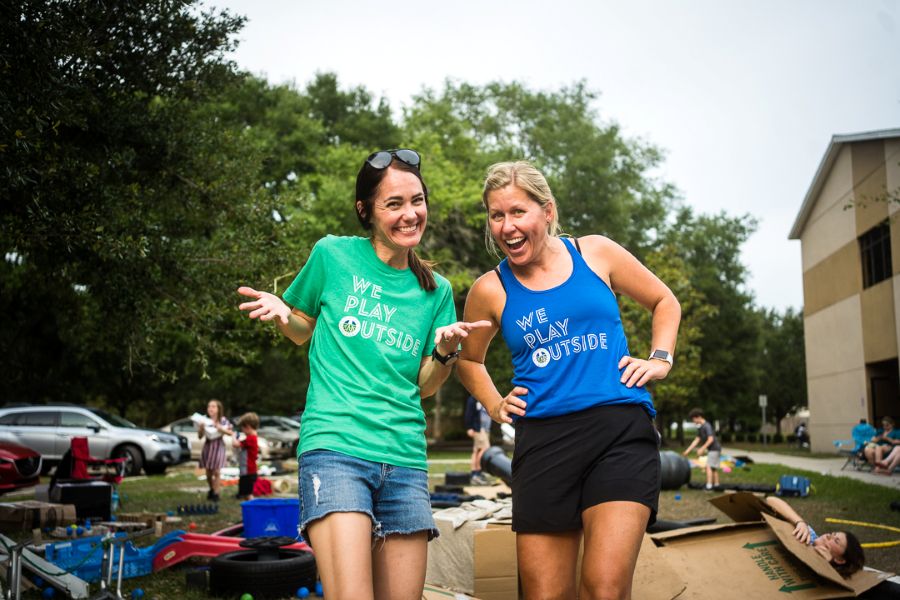
Launched in 2019, Rooted in Play holds free monthly “pop-up play’’ events at Tampa parks where kids decide how they want to play with the various “loose parts” that Willman and Givens, who call themselves “playworkers,’’ scatter around for them. Rooted in Play also holds play camps when school is out.
They’ll bring pans and water for making mud pies to the pop-up events and are always seeking donations of adult T-shirts the kids can wear over their clothes for messy activities. They also set up a table for kids to paint pictures.
“No planned art,’’ Willman says. “No, ‘Let’s make a tree today.’ It’s, ‘Here are the materials. Enjoy.’”
The nonprofit is funded by the Children’s Board of Hillsborough County.
The benefits
Givens, a speech and language pathologist, says documented and researched benefits from this type of play include increased attention, problem-solving skills, critical thinking, developing fine motor skills, communication, collaboration, planning, organization, independence, and other “21st century skills.”
Many kids today are registered in structured after-school enrichment programs and never get a chance to join in child-led play, Givens says. And not as many kids go outside and play in their neighborhoods these days. Givens believes that’s because more parents are concerned about their children’s safety, and fewer people know their neighbors anymore. So the neighbors may not be keeping an eye on their children. Willman says it’s gotten to the point that a neighbor might call the authorities to report, “an 8-year-old walking a dog alone.’’
The effort to bring back free play for children is a worldwide movement, they say. Willman, a photographer, discovered that when she attended a conference in Houston dedicated to adventure playgrounds. Shooting pictures of the conference for the organizers, she met playworkers from across the U.S. and from countries like Tasmania and Spain.
“The first night of that conference, I emailed Ashli from my hotel room, ‘Oh, I think I know what we need to do with our lives,’” Willman says.
When she asked about starting an organization in Tampa offering free play events, the advice she received was build a community of people who are on board with free play.
That’s how the pop-up adventure playgrounds started. The first was on Earth Day 2019.
“We were so nervous,” Willman says. “We invited a small number of people, and half an hour into it, we looked at each other and said, ‘Oh, this is it. This is it.’’’
Sherre McCarson has been bringing her two younger boys, Braden, 8, and Brian, 6, to the events for a couple of years.
“They absolutely look forward to going every month,’’ she says. “They know that one time that month, they will get to go. They are constantly asking when camp is, when they can go to camp.”
It looks like so much fun, McCarson says, that she wishes they would put on free-play events for adults.
At the events, she says she’s seen really creative use of “useless’’ junk. Kids make ramps and have races, rolling balls down them. They’ll use a tree limb to make a tire swing. McCarson laughs, thinking about how her boys were baffled by an old rotary phone.
“They don’t even know what a rotary phone is, but to them it’s the coolest thing in the world,’’ she says.
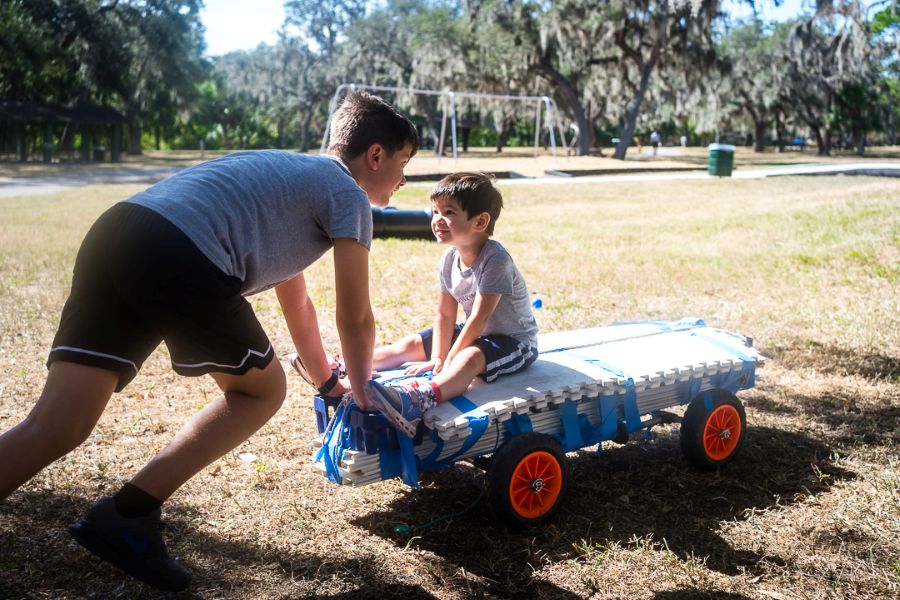
Givens says that recently, a boy made a vehicle out of junk. He took two sets of kayak cart wheels, some leftover fence pieces, and other materials, taped and tied it all together, and it rolled. He gave other kids rides, pushing them around the park.
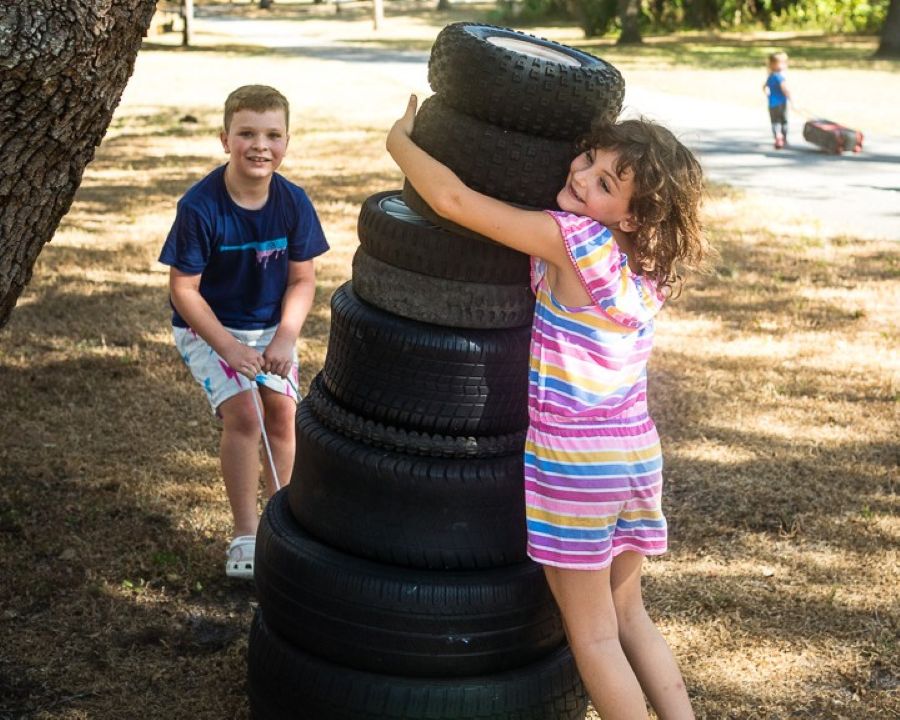
Other kids collected the tires, stacked them up, and opened a “business.’’
“They ran around and sold tires,’’ Willman says.
She says some parents and kids come to all the events, even scheduling their weekends around them. One boy who came to the first one as a baby is still coming at age 8.’
Givens says when parents come to a play event and see it firsthand, “it becomes clear to them what we’re all about and what we’re trying to preserve.” They’ll often say that they played like this as kids.
At the end of the play days, parents fill out a survey – a requirement of the Children’s Board grant.
Parents say things like, ‘I smiled all the way home,’” Willman says. “I saw my kid solve a problem.’’
The playworkers also give them a bag of “loose parts” that includes a toy dog, little wooden people and animals, and such. It’s a way to encourage the parents to allow the self-directed play to continue at home, Willman says.
The play days definitely get an endorsement from Braden and Brian, McCarson attests.
“By the time they leave, they’re wet, dirty, tired, and have had so much fun,’’ she says. “And they can’t wait to go back.’’
For more information and to register for a play day, go to Rooted in Play
This story is part of an underwriting agreement between the Children’s Board of Hillsborough County and 83 Degrees Media
Author

Related Articles
Striving for seamless social service system in Tampa Bay
Area nonprofits like Feeding Tampa Bay and Crisis Center of Tampa Bay are weaving a more connected safety net.
George Levesque leads Tampa Theatre into next chapter
New Tampa Theatre President and CEO George Levesque brings a lifelong love of atmospheric theaters and a passion for creating memorable experiences.
Summer water safety in Tampa Bay area
Several water safety programs for kids are active in Hillsborough County.