Community artists go positive following state’s street mural ban
Community art projects spread a positive message to counteract negativity stirred by state’s street art ban.
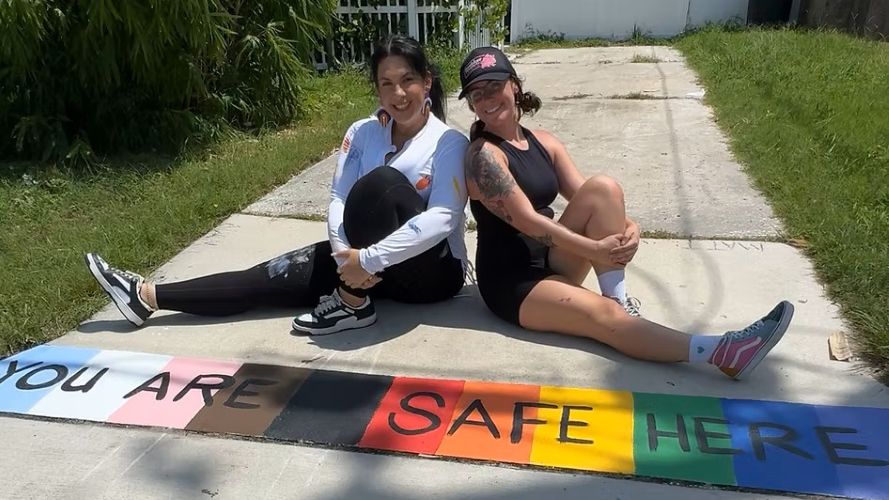
When Gov. Ron DeSantis’ administration started removing street murals across the state in August, Palm Harbor artist Michelle Sasha started painting mural art for free at homes around Pinellas County.
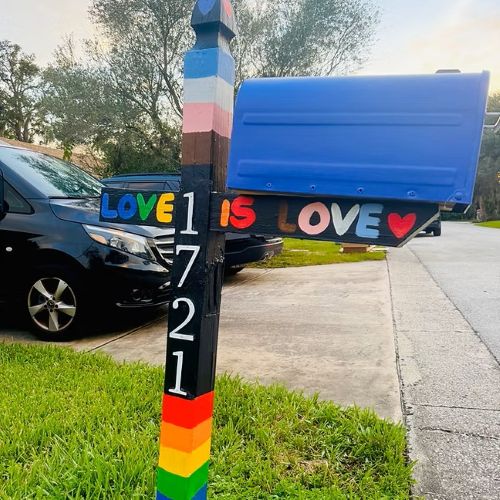
As the state’s street art ban erased the Pulse nightclub shooting memorial mural in Orlando, and community symbols like the Progressive Pride and Black History Matters murals in St. Petersburg, Sasha launched Love Thy Neighbor, a grassroots community project creating vibrant home murals with symbols and messages supporting the LGBTQ and Black communities. She says Pride and Black Lives Matter-themed street murals gave visibility to marginalized groups, and she did not want their removal to leave people feeling erased. The Pride rainbow flag and the message “Black Lives Matter” painted across the red, black, and green of the Black Liberation flag are some of the vivid mural designs available for driveways and mailboxes.
“For me, it was an opportunity I had to take action when a lot of people did not have the same opportunity,” Sasha says. “As an artist, I can actually create things with a message that can help people feel seen, can help people deal with the feeling of being removed. It felt like something I had to do.”
Within weeks of launching, Love Thy Neighbor had more than 200 people signed up to get murals and several artists helping paint the artwork. Artists Jazzy Erickson and Zach”lyko” Shaffer had stepped up to help run the project, which is currently focused on Pinellas County with hopes to expand to Hillsborough, Pasco, Bradenton, and beyond.
Sasha’s prior experience devising and running a community art initiative and her professional connections have helped Love Thy Neighbor flourish. In 2021, she launched a project painting free palm tree mini-murals on homes, businesses, and community buildings around Palm Harbor. It took off and became popular around town. She also runs a business, ArtFluent Creatives, that connects artists with mural project opportunities.
The road to this community project started in late June when the Florida Department of Transportation FDOT sent out a memo announcing street art with “social, political, or ideological messages or images” violated a new state law and local governments that did not comply and remove them would have state transportation funding withheld. FDOT officials said under a new state and federal policy, traffic control devices, including pavement markings, have to follow the FDOT Design Manual and federal guidelines. On July 1, the U.S. Department of Transportation fired off a memo announcing a similiar initiative.
FDOT has also said street murals are a safety hazard that could distract drivers. That’s a significant about-face from FDOT’s 2020 Excellence in Transportation Planning Awards, when the City of Tampa’s Crosswalks to Classrooms street art program near schools won the agency’s Planning Innovation of the Year award. Multiple before-and-after studies out there show reduced speeds, a decline in crashes, and imporved walkability after street murals and painted crosswalks are installed. Bloomberg Philanthropies 2022 Asphalt Art Safety Study “found significantly improved safety performance across a variety of measures during periods when asphalt art was installed.”
In late August, the FDOT began its mural purge by covering over the Pulse memorial mural in the dark of night. Eventually, the state’s ban claimed all street murals, including the pro-police “Back the Blue” mural outside Tampa Police Department headquarters and the crosswalk art installed for student safety near schools in Tampa.
“For me, as an artist, it was really sad to see the art go,” Sasha says. “There were murals that had messages about inclusivity and marginalized groups, which some people consider political. To me, it’s not a political issue; it’s a humanity issue. People should love who they love and be who they are. And while a lot of the murals were removed because of the political climate, a lot of the murals removed were not political at all. There were a lot caught in the crosshairs that had nothing to do with any type of messaging whatsoever. They were just beautiful art created by really beautiful artists who were creating spaces safer than your standard crosswalk.”
Love Thy Neighbor is one of the grassroots community efforts using art to spread a positive message that counteracts the anger and dismay stirred by the state’s order erasing street art.
In Tampa, mural artist Cam Parker, better known as Painkiller Cam, and LGBTQ ally organization PFLAG Tampa plan to collaborate on a community art project that celebrates Tampa’s LGBTQ history with a large mural at the Corner Club in Old Seminole Heights. Currently, PFLAG Tampa is taking nominations of iconic people, places, and things to include in the mural. A fundraising drive to pay for the project runs through November 30th.
“We want to put something up that the community, the city, and the Bay Area in general can look at and say, ‘Yes! I know that. I feel a sense of ownership of that,” Parker says. “For people who don’t feel a sense of belonging, but felt seen and heard just crossing the street, to only have those murals erased and covered with asphalt, we’re trying to do something that’s a beautiful reaction. Because I don’t want to be part of anything where I’m not fighting a good fight. Let people know, ‘Yes, it’s a reaction to the erasure of these murals, but this is going to be nothing but love. So if you’re not on that side of history, then this isn’t for you.’”
As an artist, Parker was part of two mural projects removed. During the City of Tampa’s Art on the Block Day in June 2020, he was lead artist on the “Unity Mural,” a street mural at Henderson Avenue and Franklin Street in Tampa Heights that symbolized the LGBTQ community’s solidarity with the Black Lives Matter movement. He was also one of the artists who created the Black History Matters mural in front of the Woodson African American Museum of Florida in St. Pete’s The Deuces neighborhood.
During the Woodson’s Free Museum Day event in September, a crowd holding green, yellow, and red sheets of construction paper over their heads reimagined Black History Matters as a human mural.
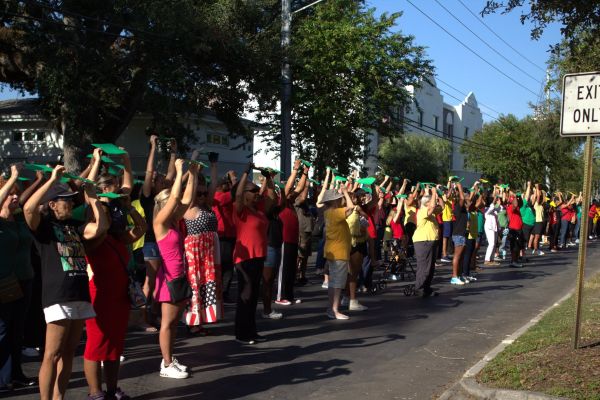
“IF ONLY you knew how deeply humbled we were to have seen so many individuals standing with us in our mission to preserve, present, and protect Black History,” the Woodson posted on Facebook after the event. “IF ONLY you know how grateful we remain, knowing we have allies who boldly proclaim that we will not be moved and that Black History truly matters.”
On Labor Day In St. Pete’s Grand Central District, the LGBTQ community and their supporters spread out along the 2300 to 2500 blocks of Central Avenue in St. Pete’s Grand Central District and created sidewalk chalk art protesting the state’s. At the time, crews had not yet removed the Progressive Pride rainbow street mural painted at the intersection of Central and 25th Street to symbolize Grand Central’s status as the birthplace of St. Pete Pride in 2003.
That day, chalk art covered the sidewalks with messages like “Hate Has No Home Here,” “You Won’t Silence Our Pride,” and “Love is Love,” along with some salty words directed at DeSantis.
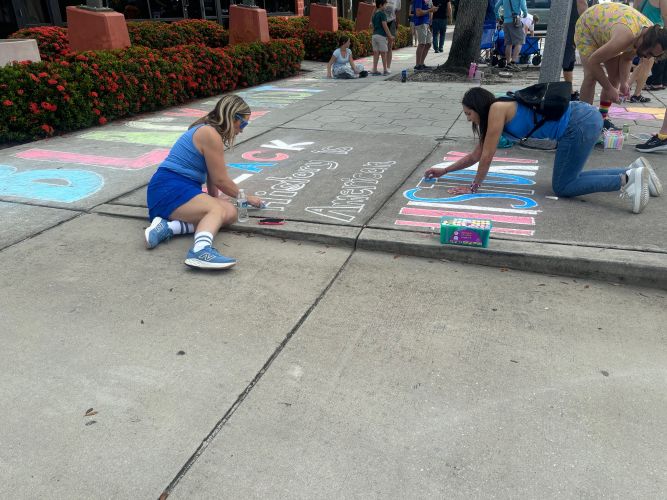
Grassroots group #StandUpStPete organized the event. Organizer Rachel Covello handed out chalk and art supplies at a table in front of LGBTQ club Cocktail St. Pete, where a bright new rainbow mural now adorns the front windows.
“Today’s all about getting the community out, showing our collective efforts to remind people that we’re still here, remind the governor that we’re still here, and spread good trouble, as everybody’s been calling it,” Covello says during the Labor Day event. “We’re writing messages of hope, love, some anger. We’re going to keep the message going that we are here, we are queer, and we’re not going anywhere.”
Covello runs an LGBTQ travel blog and says removing the Progressive Pride mural sends a message that can have negative consequences for the local economy.
“I love this destination,” she says. “I love how inclusive this destination is. I see how negatively this impacts our tourism industry. A lot of money comes here. When you start erasing things, it removes that welcome mat everybody loves to see. We’re putting up new welcome mats. We’re temporarily adding rainbows to the sidewalks and working with the city on something more permanent.”
Paul Fontaine, another organizer, says the chalk art protest was intended as a show of community unity and resilience. He says community members are working with the Grand Central District and the City of St. Petersburg to hopefully collaborate on more permanent public art.
As of late October, the St. Pete City Council and Mayor Ken Welch continue to discuss, debate, and wrangle over how the city responds to the removal of its five street murals. Options suggested in a community survey include murals on city-owned parking lots, garages, and buildings; collaborating with the St. Pete Arts Alliance on the SHINE Mural Festival; a unity celebration day, distributing Pride and Black History Matters flags, commissioning a piece of public art, rainbow bicycle racks, murals on top of hangars at Albert Whitted Airport, a unity message on I-275 billboards, and t-shirts.
In that online survey, community members said the city’s murals, particularly Pride and Black History Matters, gave a sense of belonging and inclusion. They cultivated community pride and identity, were part of the city’s arts DNA, improved safety, and created a sense of place.
In Tampa and Hillsborough County, community nonprofit Sidewalk Stompers, launched the local National Walk to School Day event in 2019. Ten schools participated that first year. On October 8th, the 2025 walk reached 35 schools and more than 5,000 students, all-time highs for the local event.

Sidewalk Stompers promotes walking and biking to school for student health and advocates for infrastructure improvements and other solutions creating safe routes to schools. In past years, colorful crosswalk art was high on Sidewalk Stompers’ list of priority safety enhancements. They slowed traffic and made for safer crossings, says the group’s President Emily Hinsdale.
This year, those murals are gone, covered over in black paint. Among them, the mural of President Theodore Roosevelt that artist Jay Giroux painted outside Sidewalk Stompers’ first community partner school, Tampa’s Roosevelt Elementary. Hinsdale says the murals represented an artist’s creativity and a school’s identity, and it’s disheartening to see them erased.
The more significant concern, she says, is the safety of students walking and biking to school. Contrary to the state’s claim of distracted driving, Hinsdale says several studies and statistical reports show crashes declining after crosswalk art is installed. Bloomberg Philanthropies’ 2022 study showed a 50 percent decrease in the rate of crashes involving pedestrians and “other vulnerable road users,” a 37 percent decrease in the rate of crashes leading to injuries, and a 17 percent decrease in the overall crash rate.
Hinsdale says Sidewalk Stompers’ response to the state’s street mural purge is to keep on with its mission.
“For us, it just becomes all the more urgent to do the programs that Sidewalk Stompers brings to schools,” she says. “As we have more and more safety measures that protect our children on their way to school being removed, we need to encourage walking and biking in larger groups. We’re trying to protect our walkers and our bikers. So many of our children don’t have another way of getting to school.”
Author
Related Articles
St Petersburg Distillery unveils vision for creators’ district
Family-owned craft distillery wants the community to shape St. Pete’s next arts and creative district.
FloridaRAMA showcases Lucy Sparrow’s homage to convenience stores
The globe-hopping felt artist’s latest installation recreates a Florida convenience store.

Take a Tampa adventure with local artist Mishou Sanchez
The local artists’s coloring book, “Poppi Pink’s Tampa Adventure,” explores the city through a pop-surreal lens.